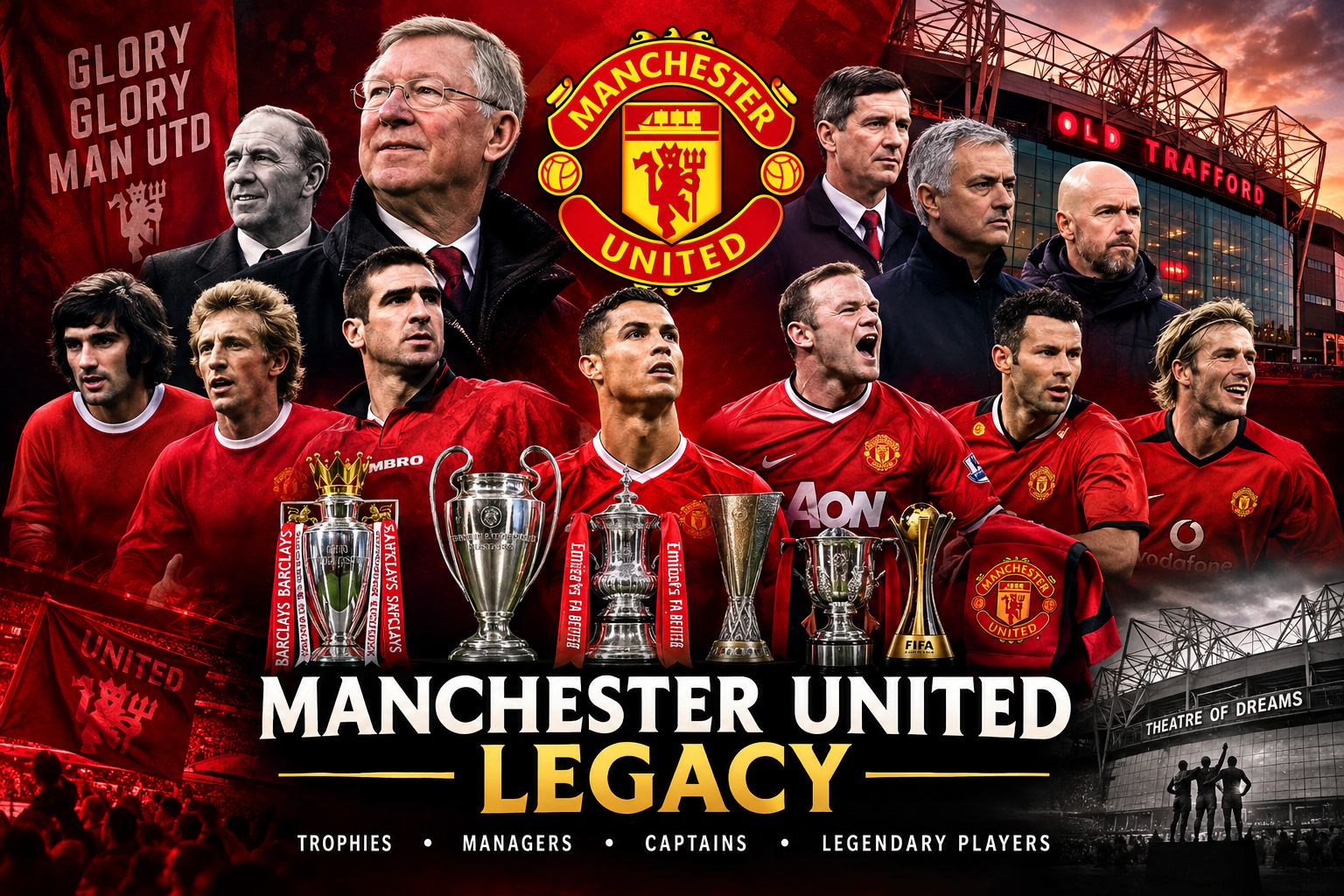
Manchester United Football Club Legacy: Trophies, Managers, Captains and Legendary Players
Manchester United Football Club Legacy: Trophies, Managers, Captains and Legendary Players
Manchester United Football Club is one of the most historic names in world football. From its origins as Newton Heath in 1878 to its transformation into Manchester United in 1902, the club has built a legacy shaped by league championships, European triumphs, iconic managers, legendary captains, famous academy graduates and generations of unforgettable players.
Based at Old Trafford, United have experienced extraordinary highs and difficult periods, but the club’s identity has consistently been connected with ambition, attacking football, youth development and a determination to compete for major honours.
As of 2026, Manchester United’s official honours list includes 20 English league titles, 13 FA Cups, six League Cups, three European Cups/UEFA Champions League titles, one UEFA Europa League, one UEFA Cup Winners’ Cup, one UEFA Super Cup, one FIFA Club World Cup and one Intercontinental Cup, among other honours.
This is the story of the Manchester United legacy — its trophies, managers, captains, legendary players, academy tradition and the moments that made the club famous around the world.
Manchester United History: From Newton Heath to a Global Football Giant
Manchester United’s story began in 1878, when the club was founded as Newton Heath L&YR Football Club. The team originally had connections to the Lancashire and Yorkshire Railway.
The club entered the English Football League’s top division in 1892 before financial difficulties threatened its existence. In 1902, the club was renamed Manchester United Football Club.
That change marked the beginning of a remarkable transformation.
United won their first English league championship in 1908, followed by another in 1911. The club also won its first FA Cup in 1909.
In 1910, Manchester United moved into Old Trafford, which would eventually become one of the most recognizable football stadiums in the world.
Known worldwide as the “Theatre of Dreams,” Old Trafford became the stage for generations of Manchester United legends.
Manchester United Trophy Cabinet
Manchester United’s honours list tells much of the story behind the club’s reputation.
Major Manchester United trophies
| Competition | Titles |
|---|---|
| English League / Premier League | 20 |
| FA Cup | 13 |
| League Cup | 6 |
| UEFA Champions League / European Cup | 3 |
| UEFA Europa League | 1 |
| UEFA Cup Winners’ Cup | 1 |
| UEFA Super Cup | 1 |
| FIFA Club World Cup | 1 |
| Intercontinental Cup | 1 |
| FA Community Shield | 21 |
| Football League Second Division | 2 |
| FA Youth Cup | 11 |
These figures come from Manchester United’s official trophy room.
The club’s 20 league championships remain one of the defining achievements in English football history, while its three European Cup/Champions League victories came in 1968, 1999 and 2008.
Manchester United League Titles
Manchester United have won the English top-flight championship 20 times.
Their league titles came in:
1908, 1911, 1952, 1956, 1957, 1965, 1967, 1993, 1994, 1996, 1997, 1999, 2000, 2001, 2003, 2007, 2008, 2009, 2011 and 2013.
The first two championships came before the First World War.
However, the club’s greatest periods of league dominance came under two managers:
- Sir Matt Busby
- Sir Alex Ferguson
Busby established Manchester United as a major force in post-war English football, while Ferguson transformed the club into a dominant Premier League institution.
The Busby Era: Manchester United’s First Golden Age
When Sir Matt Busby arrived at Manchester United in 1945, the club was about to enter one of the most important periods in its history.
Busby worked closely with coach Jimmy Murphy and placed enormous importance on youth development.
The approach produced the famous Busby Babes, a young Manchester United team that captured the imagination of football supporters.
United won the league championship in 1952, 1956 and 1957.
The team was built around young players developed through the club’s system, demonstrating a philosophy that would become one of the defining characteristics of Manchester United: developing young footballers rather than relying entirely on expensive transfers.
The Munich Air Disaster and Manchester United’s Resilience
Manchester United’s history cannot be discussed without remembering the Munich air disaster of 1958.
The tragedy claimed the lives of eight Manchester United players, along with other passengers and staff. The disaster devastated a young team that had been developing into one of Europe’s leading sides.
Yet the club rebuilt.
Busby eventually assembled another outstanding Manchester United team featuring players such as:
- Bobby Charlton
- Denis Law
- George Best
Together, these stars became known as the club’s famous “Holy Trinity.”
Their achievements culminated in Manchester United winning the 1968 European Cup, making the club the first English side to win Europe’s premier club competition.
That victory remains one of the most emotional chapters in Manchester United history.
The Holy Trinity: Bobby Charlton, Denis Law and George Best
Few attacking combinations in football history are as famous as Manchester United’s Holy Trinity.
Sir Bobby Charlton
Bobby Charlton was a survivor of the Busby era and became one of the greatest players in English football history.
His career at United was defined by:
- European Cup success
- League championships
- FA Cup success
- extraordinary goalscoring from midfield
- leadership and longevity
Charlton was central to United’s 1968 European Cup triumph.
Denis Law
Denis Law brought exceptional finishing ability and attacking intelligence to Manchester United.
The Scottish striker became one of the defining players of the 1960s team.
George Best
George Best was one of football’s most naturally gifted entertainers.
His dribbling, balance, creativity and ability to beat defenders made him a global superstar.
The three players — Charlton, Law and Best — represented different qualities, but together formed the attacking heart of Manchester United’s greatest team of the 1960s.
Manchester United in the 1970s and 1980s
Following Busby’s departure, Manchester United entered a period of transition.
The club experienced managerial changes, fluctuating league performances and eventually relegation from the top division in the 1970s.
However, United recovered quickly and returned to the top flight.
The club won the FA Cup in 1977, 1983 and 1985, with managers such as Tommy Docherty and Ron Atkinson overseeing important periods of rebuilding.
The 1980s produced talented players including:
- Bryan Robson
- Norman Whiteside
- Mark Hughes
- Arthur Albiston
- Clayton Blackmore
Ron Atkinson’s teams were particularly successful in the FA Cup, winning the competition in 1983 and 1985.
But the league championship remained elusive.
Then came the appointment that changed everything.
Sir Alex Ferguson: The Manager Who Changed Manchester United Forever
In 1986, Manchester United appointed Alex Ferguson as manager.
The early years were difficult, but Ferguson gradually transformed the club.
United won the FA Cup in 1990, providing the foundation for a period of extraordinary success.
Ferguson’s philosophy combined:
- youth development
- aggressive attacking football
- elite recruitment
- tactical flexibility
- squad competition
- leadership
- psychological resilience
The arrival of players such as Eric Cantona helped United end their long wait for a league championship.
When the Premier League began in 1992, Ferguson was ready to build a new Manchester United dynasty.
Manchester United and the Premier League Era
Manchester United won the inaugural Premier League title in 1992/93.
The club subsequently won the Premier League in:
- 1993
- 1994
- 1996
- 1997
- 1999
- 2000
- 2001
- 2003
- 2007
- 2008
- 2009
- 2011
- 2013
That gives United 13 Premier League championships.
The Ferguson era became synonymous with domestic dominance.
The Class of ’92: Manchester United’s Greatest Academy Generation
One of the most important features of Ferguson’s Manchester United was the club’s commitment to youth development.
The Class of ’92 became the most famous example.
The group included:
- David Beckham
- Ryan Giggs
- Paul Scholes
- Gary Neville
- Phil Neville
- Nicky Butt
These players emerged from Manchester United’s youth system and became major contributors to the club’s greatest teams.
The academy’s importance had deep roots going back to Busby’s era. Ferguson continued that tradition, helping establish youth development as a central part of United’s identity.
The Class of ’92 ultimately became a symbol of what Manchester United could accomplish when world-class coaching was combined with elite youth development.
The 1999 Treble: Manchester United’s Most Famous Season
The 1998/99 season occupies a special place in Manchester United history.
United won:
- Premier League
- FA Cup
- UEFA Champions League
The achievement became known simply as the Treble.
The Champions League final against Bayern Munich at Camp Nou produced one of the most famous endings in European football.
Manchester United scored twice in stoppage time to win the Champions League.
The victory completed an extraordinary season and established the 1999 team as one of the most celebrated squads in club football history.
The 2008 Champions League Triumph
Manchester United won the Champions League again in 2008.
The final against Chelsea was decided by a penalty shootout after a 1-1 draw.
The team featured stars including:
- Cristiano Ronaldo
- Wayne Rooney
- Ryan Giggs
- Paul Scholes
- Rio Ferdinand
- Nemanja Vidić
- Edwin van der Sar
- Patrice Evra
Ronaldo scored United’s goal in normal time, while Edwin van der Sar made the decisive save in the shootout.
The victory gave United their third European Cup/Champions League title.
Manchester United’s 2008 FIFA Club World Cup
Later in 2008, United won the FIFA Club World Cup, defeating LDU Quito in the final.
This made the 2008 team champions of both Europe and the world.
It was another landmark moment in the Ferguson era.
Wayne Rooney and Cristiano Ronaldo: A New Generation of United Icons
The 2000s produced another generation of Manchester United superstars.
Cristiano Ronaldo
Cristiano Ronaldo joined Manchester United as a teenager and developed into one of the most famous footballers in the world.
His United career included:
- Premier League titles
- Champions League success
- FIFA Club World Cup success
- Ballon d’Or recognition
- extraordinary goalscoring
His 2007/08 season was particularly memorable, as he scored 42 goals in all competitions and helped United win both the Premier League and Champions League.
Wayne Rooney
Wayne Rooney became one of United’s defining players of the post-2000 era.
He combined:
- goalscoring
- creativity
- physicality
- work rate
- versatility
Rooney became Manchester United’s all-time leading goalscorer, surpassing Sir Bobby Charlton’s previous record.
Manchester United’s Legendary Players
The club’s history contains an extraordinary collection of footballing icons.
Sir Bobby Charlton
A key figure of the Busby era and 1968 European Cup winner.
George Best
A dazzling winger whose skill and charisma made him one of football’s most famous players.
Denis Law
A prolific striker and key member of the Holy Trinity.
Eric Cantona
Cantona’s arrival transformed Manchester United’s attack and coincided with the club’s return to league dominance in the 1990s.
Ryan Giggs
Giggs became one of the defining players of the Ferguson era.
His longevity was remarkable, and he accumulated a huge collection of medals during his United career.
Paul Scholes
One of the most technically gifted midfielders produced by the Manchester United academy.
David Beckham
Beckham became famous for his crossing, free kicks and long-range passing.
His rise from the Class of ’92 to global superstar made him one of United’s most recognizable players.
Roy Keane
Keane was a fierce midfielder and influential captain whose leadership became synonymous with Ferguson’s greatest teams.
Bryan Robson
Robson was one of United’s most important captains before the Ferguson dynasty reached its peak.
Peter Schmeichel
The Danish goalkeeper played a crucial role in the 1990s and was an essential member of the 1999 Treble-winning team.
Rio Ferdinand
Ferdinand became a key component of United’s defensive strength during the 2000s.
Nemanja Vidić
Vidić formed an outstanding defensive partnership with Ferdinand and became one of the club’s most respected defenders.
Cristiano Ronaldo
Ronaldo developed from a promising teenager into a global superstar during his first United spell.
Wayne Rooney
Rooney combined goals, assists and extraordinary work rate and became the club’s record goalscorer.
Robin van Persie
His arrival from Arsenal in 2012 was decisive in United’s 2012/13 title campaign. He scored a hat-trick against Aston Villa to help secure the club’s 20th league championship.
Manchester United’s Greatest Captains
Leadership has always been an important part of the club’s identity.
Some of the most notable Manchester United captains include:
Charlie Roberts
Roberts was an important figure in United’s early history and captained the team during its first major period of success.
Roger Byrne
Byrne captained the Busby Babes and lifted league championship trophies in 1956 and 1957.
Bobby Charlton
Charlton represented the club during its recovery from Munich and its rise to European champions.
Bryan Robson
Robson was a powerful and influential captain during the 1980s.
Steve Bruce
Bruce captained United during the early Ferguson era and helped establish the team’s defensive foundation.
Eric Cantona
Cantona’s leadership and personality became central to United’s transformation in the 1990s.
Roy Keane
Keane captained Manchester United during one of the most successful periods in the club’s history.
Gary Neville
Neville represented the club’s academy tradition and later became captain of Ferguson’s team.
Nemanja Vidić
The Serbian defender became a major defensive leader and captained United during another successful period.
Harry Maguire
Maguire was appointed club captain in 2020 and wore the armband during an important transitional period.
Bruno Fernandes
Bruno Fernandes is a leading modern United figure and continues to captain the team. Manchester United’s official player profile describes him as a major dressing-room influence and notes his leadership in major cup finals.
Manchester United Managers: The Men Who Shaped the Club
Managers have played an enormous role in United’s history.
Ernest Mangnall
Ernest Mangnall is widely regarded as Manchester United’s first manager.
He helped establish the club as an important force in English football in the early 20th century. Under his leadership, United won the 1908 league championship and 1909 FA Cup.
Sir Matt Busby
Busby is one of the central figures in Manchester United history.
His achievements included:
- rebuilding the club after the Second World War
- developing the Busby Babes
- winning league championships
- rebuilding after Munich
- winning the 1968 European Cup
His philosophy established youth development as part of United’s DNA.
Tommy Docherty
Docherty led United to the FA Cup in 1977 and helped restore the club after relegation.
Ron Atkinson
Atkinson won the FA Cup twice, in 1983 and 1985.
Sir Alex Ferguson
Ferguson became the most successful manager in Manchester United history.
His achievements include:
- 13 Premier League titles
- multiple FA Cups
- multiple League Cups
- two Champions League titles
- the 1999 Treble
- the 2008 FIFA Club World Cup
- the club’s 20th league championship
He retired after winning the 2012/13 Premier League title.
David Moyes
Moyes succeeded Ferguson in 2013 but left during the 2013/14 season. Ryan Giggs then served as interim manager.
Louis van Gaal
Van Gaal managed United from 2014 to 2016 and won the 2016 FA Cup.
José Mourinho
Mourinho became United manager in 2016 and won three trophies during his first season:
- UEFA Europa League
- League Cup
- Community Shield
Manchester United’s official history records his 2016 appointment and the three trophies he won during his first season.
Ole Gunnar Solskjær
The former United striker returned as manager in 2018 and was appointed permanently in 2019.
His tenure included a run to the 2021 Europa League final.
Ralf Rangnick
Rangnick took interim charge during the 2021/22 season.
Erik ten Hag
Ten Hag became manager in 2022 and led United to the 2023 League Cup, ending a major-trophy drought.
Ruben Amorim
Amorim replaced Ten Hag but left the position in January 2026. The Premier League reported Manchester United’s announcement of his departure on 5 January 2026.
Michael Carrick
As of September 2026, Michael Carrick is Manchester United’s head coach. Current reporting identifies Carrick as United’s head coach for the 2026/27 season.
Carrick is particularly notable because he previously played for Manchester United and won major honours with the club, including Premier League titles, the Champions League, Europa League and FIFA Club World Cup.
The Manchester United Academy Legacy
One of the most important parts of the Manchester United identity is the youth academy.
The club has produced generations of first-team players.
Famous academy graduates include:
- Duncan Edwards
- Bobby Charlton
- George Best
- Mark Hughes
- Norman Whiteside
- Ryan Giggs
- David Beckham
- Paul Scholes
- Gary Neville
- Phil Neville
- Nicky Butt
- Marcus Rashford
The academy has won the FA Youth Cup 11 times, according to the club’s official honours list.
The academy tradition connects the Busby era with Ferguson’s greatest teams and continues to influence the club’s identity.
Manchester United’s Greatest European Nights
United’s European history contains several iconic moments.
1968 — First European Cup
Manchester United defeated Benfica to win the European Cup at Wembley, becoming the first English club to win the competition.
1999 — Treble Champions
United defeated Bayern Munich in one of the most dramatic Champions League finals ever played.
2008 — Champions of Europe
United defeated Chelsea on penalties in Moscow to claim their third European Cup/Champions League title.
2017 — Europa League Champions
Under José Mourinho, United defeated Ajax to win their first UEFA Europa League title. The trophy remains on the club’s official honours list.
Manchester United’s FA Cup Legacy
The FA Cup has always played an important role in United’s history.
The club won its first FA Cup in 1909.
Later victories came in:
1948, 1963, 1977, 1983, 1985, 1990, 1994, 1996, 1999, 2004, 2016 and 2024.
The 1999 FA Cup victory formed part of the Treble.
The 2024 FA Cup victory added another major trophy to the club’s modern honours list.
Manchester United and the Treble
The word “Treble” has a special place in Manchester United history.
In 1999, Ferguson’s team became English football’s most famous treble-winning side of its era by winning:
- Premier League
- FA Cup
- Champions League
The 1999 team combined experienced leaders such as Peter Schmeichel, Roy Keane and Denis Irwin with younger stars such as David Beckham, Paul Scholes and Ryan Giggs.
The result was a team remembered not only for trophies but for its ability to recover from difficult situations.
The Manchester United Playing Philosophy
Although managers have changed dramatically over more than a century, certain themes have repeatedly appeared in Manchester United’s history.
Youth development
From Busby’s academy philosophy to the Class of ’92 and later graduates, young players have frequently played important roles.
Attacking football
United’s greatest sides have traditionally been associated with attacking ambition.
Character
From the rebuilding after Munich to late comebacks under Ferguson, resilience has become part of the club’s football culture.
Global ambition
The club’s success helped transform Manchester United into a global sporting brand with supporters around the world.
Old Trafford: The Theatre of Dreams
Old Trafford opened in 1910 and became Manchester United’s permanent home.
The stadium has witnessed:
- league championships
- European finals
- FA Cup celebrations
- dramatic comebacks
- debuts of legendary players
- farewell appearances from club icons
During the Second World War, Old Trafford was badly damaged by bombing in 1941 and was subsequently rebuilt.
For generations of supporters, the stadium has represented more than a football ground. It is one of the physical symbols of Manchester United’s identity.
Manchester United’s Legacy Beyond Trophies
Manchester United’s legacy is not defined solely by its trophy cabinet.
The club’s story includes moments of triumph and tragedy, periods of rebuilding, remarkable academy graduates and managers who fundamentally changed English football.
The Busby era demonstrated the power of youth development.
The 1968 European Cup victory demonstrated United’s arrival on the European stage.
The Ferguson era transformed the club into a dominant Premier League force.
The Class of ’92 demonstrated the possibilities of an elite academy.
The 1999 Treble became one of the most famous achievements in English club football.
The 2008 Champions League triumph confirmed United’s ability to compete at the highest level of European football.
Manchester United Legacy: Key Facts
Founded: 1878 as Newton Heath L&YR Football Club
Renamed: Manchester United, 1902
Home stadium: Old Trafford
First league title: 1908
League titles: 20
Premier League titles: 13
FA Cups: 13
League Cups: 6
European Cup/Champions League: 3
Europa League: 1
European Cup Winners’ Cup: 1
FIFA Club World Cup: 1
Intercontinental Cup: 1
Community Shields: 21
FA Youth Cups: 11
Current head coach in 2026: Michael Carrick
Conclusion: The Enduring Legacy of Manchester United
Manchester United’s legacy has been built across more than a century of English and European football.
From Newton Heath to Manchester United, from Ernest Mangnall to Sir Matt Busby and Sir Alex Ferguson, and from Charlie Roberts and Bobby Charlton to Roy Keane, Ryan Giggs, Wayne Rooney and Bruno Fernandes, the club’s history is a story of constantly changing generations.
The trophy cabinet contains 20 league titles, 13 FA Cups, six League Cups and three European Cups/Champions League titles, alongside numerous other domestic and international honours.
But the Manchester United story goes beyond silverware.
It is the story of the Busby Babes, the tragedy and rebuilding after Munich, the Holy Trinity, the rise of the Class of ’92, the extraordinary 1999 Treble, the European triumph of 2008 and the generations of academy players and managers who have shaped the club.
Manchester United’s history therefore remains one of the richest stories in football: a combination of trophies, legendary players, influential managers, iconic captains, youth development, dramatic matches and an extraordinary global following.
Manchester United’s legacy is not one single era. It is the accumulation of generations — each adding another chapter to the story of one of football’s most famous clubs