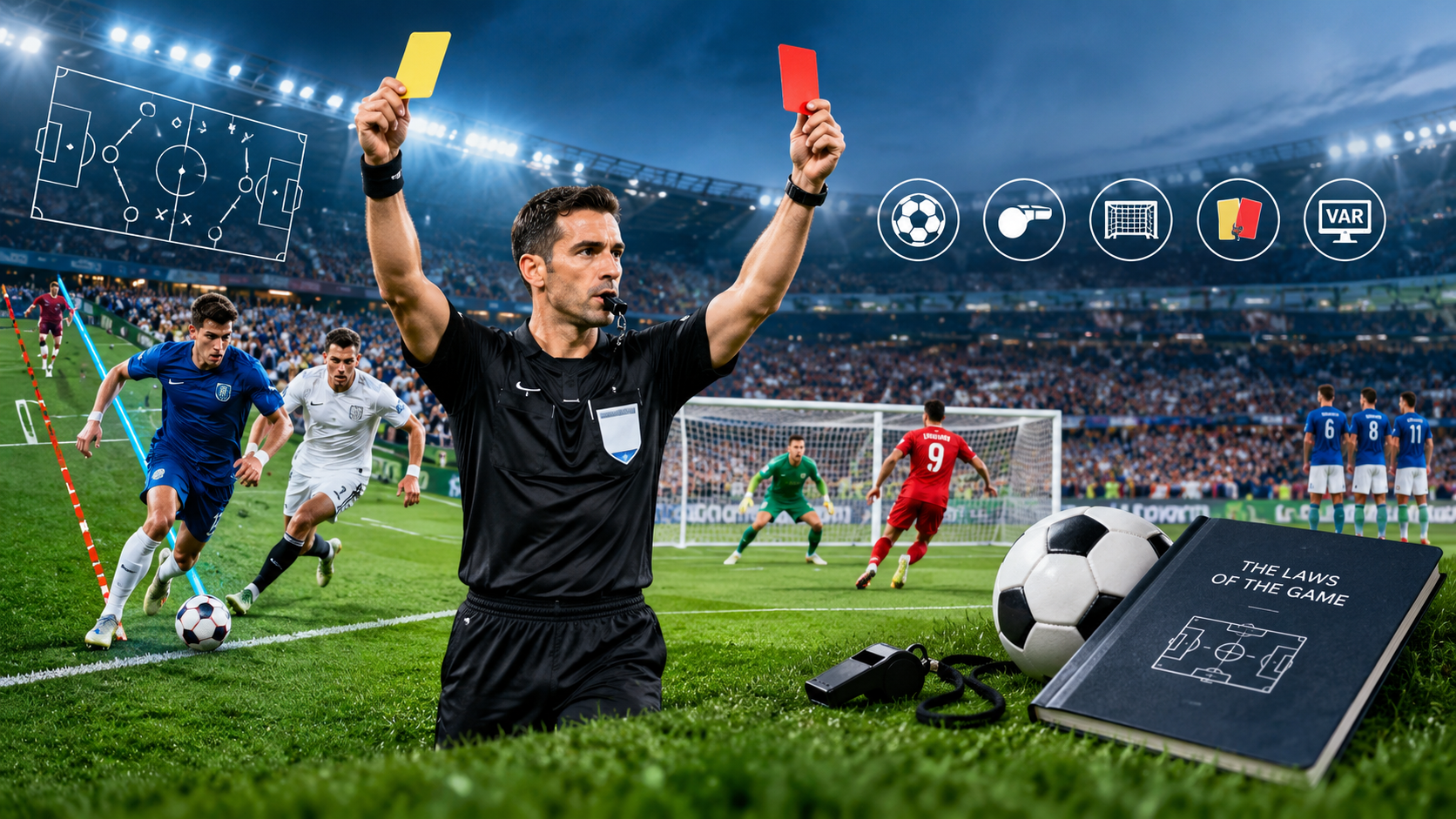
Football Rules: What Every Player Needs to Know in 2026/27
Football Rules: What Every Player Needs to Know in 2026/27
Football is much more than scoring goals, making tackles and showing off technical skills. Every player needs to understand the rules of the game to make better decisions, avoid unnecessary fouls and understand refereeing decisions.
From offside and handball to free kicks, penalties, yellow cards, red cards and substitutions, knowing the Laws of the Game can make a major difference to how players approach a match.
Whether you are a beginner, school footballer, academy player, amateur footballer or experienced player, this guide explains the essential football rules every player should know in 2026/27.
Why Every Football Player Should Know the Rules
A player who understands football rules can make better decisions under pressure.
For example, an attacker who understands the offside rule can time runs more effectively. A defender who understands what constitutes a reckless challenge can avoid unnecessary cards. A goalkeeper who knows the rules governing handling and restarts can make safer decisions.
Rule knowledge can help players improve in several areas:
- Better decision-making
- Fewer unnecessary fouls
- Improved tactical awareness
- Better communication with teammates
- Greater understanding of refereeing decisions
- Improved discipline
- Better understanding of set pieces
- More confidence during matches
The Most Important Football Rules Players Need to Know
1. Number of Players
A standard football match is played between two teams, with each team permitted a maximum of 11 players on the field.
One player must be the goalkeeper.
A match cannot start or continue if a team has fewer than seven players, subject to the provisions of the Laws of the Game and competition regulations.
Players should also understand that a red card can reduce a team to fewer players because a sent-off player cannot normally be replaced.
2. Match Objective
The objective of football is straightforward: score more goals than the opposition.
A goal is scored when the entire ball crosses the goal line between the goalposts and underneath the crossbar, provided the attacking team has not committed an offence.
Players should continue playing until the referee stops the game.
3. The Offside Rule
Offside is one of the most important rules for attacking players and defenders to understand.
Being in an offside position is not automatically an offence.
Generally, a player is in an offside position when part of their head, body or feet is in the opponents’ half and nearer to the opponents’ goal line than both the ball and the second-last opponent.
However, the player must become involved in active play for an offside offence to occur.
When Can an Attacker Be Offside?
An attacker may be penalized if they are in an offside position when a teammate plays or touches the ball and they subsequently become involved in active play in one of the ways defined by the Laws.
When Is There No Offside?
A player cannot be penalized for receiving the ball directly from:
- A goal kick
- A throw-in
- A corner kick
Tip for Attackers
Don’t only watch the ball.
Watch the defensive line and time your run.
Good movement can allow an attacker to get behind defenders while remaining onside.
4. Handball
Not every contact between the ball and a player’s hand or arm is automatically a handball offence.
Players should understand that deliberate handling and certain situations involving the position of the hand or arm can result in an offence.
Outfield players should never deliberately use their hands or arms to control, stop or play the ball in circumstances prohibited by the Laws.
Handball decisions can be particularly important inside the penalty area.
5. Goalkeeper Rules
Goalkeepers have special privileges, particularly regarding the use of their hands inside their own penalty area.
However, being the goalkeeper does not mean they can use their hands anywhere on the pitch.
Outside the relevant area, goalkeepers are subject to the same restrictions as other players regarding handling the ball.
Goalkeepers should understand:
- Handling restrictions
- Penalty kicks
- Goal kicks
- Restarts
- Time management
- Fouls and misconduct
- Communication with defenders
6. Tackling and Fouls
Football allows physical challenges, but players must challenge opponents fairly.
A challenge may be considered careless, reckless or involving excessive force depending on the circumstances.
A reckless challenge can result in a yellow card, while a challenge involving excessive force and endangering an opponent’s safety can result in a red card.
Players should think about:
- Timing
- Speed
- Positioning
- Control
- The safety of the opponent
A good defender knows when to tackle and when to delay an attacker instead.
7. Free Kicks
Free kicks are awarded after certain offences.
There are two main types:
Direct free kick: A goal can generally be scored directly against the opponents.
Indirect free kick: Another player must normally touch the ball before a goal can be scored.
Players should pay attention to the referee’s signal, particularly when an indirect free kick is awarded.
8. Penalty Kicks
A penalty kick is generally awarded when a player commits a direct-free-kick offence inside their own penalty area.
For defenders, this makes discipline inside the penalty area particularly important.
Players should avoid:
- Reckless tackles
- Pulling opponents
- Pushing
- Tripping
- Deliberate handball
- Unnecessary challenges
For penalty takers, concentration and composure are essential.
9. Throw-Ins
A throw-in is awarded when the entire ball crosses the touchline and was last touched by a player from the opposing team.
The player taking the throw must use the correct technique.
The ball is normally delivered with both hands from behind and over the head, while the thrower must comply with the Laws concerning the position of the feet.
Throw-ins can be used tactically to maintain possession and create attacking opportunities.
10. Goal Kicks
A goal kick is awarded when the entire ball crosses the goal line, having last touched an attacking player, and a goal has not been scored.
Modern teams often use goal kicks to build attacks from the back.
Goalkeepers and defenders therefore need to understand positioning and passing options during goal-kick situations.
11. Corner Kicks
A corner kick is awarded when the entire ball crosses the goal line, having last touched a defending player, without a goal being scored.
Corners can create excellent scoring opportunities.
Teams may use:
- Near-post runs
- Far-post runs
- Short corners
- Low crosses
- Cutbacks
- Set-piece routines
Defenders must communicate and track runners.
12. Yellow Cards
A yellow card is a caution.
Players can receive yellow cards for various offences, including:
- Unsporting behaviour
- Dissent
- Delaying the restart
- Persistent offences
- Failing to respect the required distance
- Entering or re-entering the field without permission
- Certain fouls
Players should be particularly careful after receiving an early yellow card.
A second yellow card in the same match results in a sending-off.
13. Red Cards
A red card means the player is sent off.
Examples of offences that can result in a red card include:
- Serious foul play
- Violent conduct
- Certain denial-of-goal or goal-scoring-opportunity offences
- Offensive, insulting or abusive language or actions
- Receiving a second yellow card
- Other sending-off offences defined by the Laws
A player who has been sent off cannot normally continue playing.
14. Respecting the Referee
Players will sometimes disagree with refereeing decisions.
However, aggressive protests, insulting language and excessive confrontation can result in disciplinary action.
Players should:
- Stay calm
- Respect officials
- Avoid surrounding the referee
- Avoid aggressive gestures
- Allow the captain to communicate appropriately
- Return their attention to the match
Understanding the rules can also make refereeing decisions easier to accept.
15. Substitution Rules
Substitution rules can depend on the competition.
Players should understand their team’s competition regulations and follow the referee’s instructions when being substituted.
Under the 2026/27 Laws, there is also a 10-second time limit for a substituted player to leave the field. Taking longer can delay the substitute’s entry under the procedures established by the Laws.
Players should leave promptly when instructed to do so.
16. Player Equipment
Players must use appropriate and safe equipment.
Basic equipment includes:
- Shirt
- Shorts
- Socks
- Shinguards
- Appropriate footwear
Players should check their equipment before the match.
Jewellery and other accessories can also be subject to safety restrictions.
17. When Is the Ball Out of Play?
The ball is out of play when:
- The entire ball crosses the touchline.
- The entire ball crosses the goal line.
- The referee stops play.
If only part of the ball crosses the line, the ball remains in play.
This is particularly important around the corners and touchlines.
18. Advantage
The referee may allow play to continue after an offence when stopping play would disadvantage the team that was fouled.
This is known as advantage.
For example, if a midfielder is fouled but a teammate immediately receives the ball in a dangerous attacking position, the referee may allow the attack to continue.
Players should continue playing when advantage is given.
19. Time-Wasting
Players can be cautioned for deliberately delaying restarts.
Examples include:
- Holding onto the ball unnecessarily
- Kicking the ball away
- Delaying a free kick
- Delaying a substitution
- Preventing an opponent from taking a quick restart
Players should understand that managing the tempo of a match is different from deliberately delaying the game.
20. VAR
Video Assistant Referee technology is used in competitions that have implemented VAR.
Players should understand that certain decisions can be reviewed according to the competition’s VAR protocol.
However, players should not demand reviews aggressively or surround match officials.
Football Rules Every Defender Should Know
Defenders should have a strong understanding of:
- Offside
- Tackling
- Holding
- Pushing
- Handball
- Penalty-area offences
- Tactical fouls
- Yellow-card management
- Goalkeeper communication
A defender who understands these rules can make better decisions when facing attackers.
Football Rules Every Midfielder Should Know
Midfielders frequently compete for possession, making knowledge of fouls and disciplinary rules especially important.
They should understand:
- Tackling
- Handball
- Advantage
- Offside
- Tactical fouls
- Free kicks
- Yellow cards
- Restart procedures
Good positioning can reduce the need for risky tackles.
Football Rules Every Attacker Should Know
Attackers should focus particularly on:
- Offside
- Handball
- Fouls
- Simulation
- Penalty kicks
- Goal celebrations
- Challenges with defenders
An attacker should understand how to make legal runs and avoid unnecessary fouls when competing for the ball.
Football Rules Every Goalkeeper Should Know
Goalkeepers have a specialized role and should understand:
- When they can handle the ball
- Penalty kicks
- Goal kicks
- Restarts
- Time management
- Fouls
- Disciplinary rules
- Communication with defenders
A goalkeeper who understands the Laws can make more informed decisions under pressure.
Common Football Rule Mistakes
Many players, particularly beginners, misunderstand some basic rules.
Is every handball a foul?
No. The circumstances of the contact must be considered under the handball provisions of the Laws.
Is standing offside automatically an offence?
No. Being in an offside position by itself is not an offence.
Can a player be offside from a corner?
No. A player cannot be penalized for receiving the ball directly from a corner kick.
Can you score directly from a free kick?
Yes, when the free kick is a direct free kick and the ball legally enters the opponents’ goal.
Can a goalkeeper use their hands anywhere?
No. The goalkeeper’s special permission to use their hands does not apply everywhere on the pitch.
Can players argue with referees?
Players can communicate with officials, but dissent and disrespectful behaviour can result in disciplinary action.
How Learning Football Rules Can Improve Your Game
Rule knowledge should be treated as part of football training.
A young player may spend hours improving passing, shooting and dribbling but still make poor decisions because they don’t understand the Laws.
Learning the rules can improve:
Positioning: Understanding offside helps attackers and defenders.
Defending: Knowing what constitutes a foul helps defenders make safer challenges.
Set pieces: Knowledge of free kicks, corners and penalties improves tactical preparation.
Discipline: Understanding cardable offences can help players avoid unnecessary bookings.
Decision-making: Players can react faster when they understand what is happening.
Game intelligence: Football intelligence includes knowing not only what to do with the ball, but also how the Laws affect the situation.
Football Rules Checklist for Players
Before stepping onto the pitch, every player should understand these essential rules:
- Number of players
- Match objective
- Offside
- Handball
- Fouls
- Tackling
- Direct free kicks
- Indirect free kicks
- Penalty kicks
- Throw-ins
- Goal kicks
- Corner kicks
- Yellow cards
- Red cards
- Substitutions
- Player equipment
- Advantage
- Time-wasting
- Referee authority
- VAR procedures where applicable
Final Thoughts
Football rules are an essential part of the game.
Players who understand the Laws can make better decisions, avoid unnecessary fouls, communicate more effectively and understand why referees make particular decisions.
From offside and handball to penalties, free kicks, cards and substitutions, every footballer should know the rules that directly affect their position.
The Laws of the Game can change, and competition regulations may introduce permitted modifications. Players, coaches and teams should therefore check the current rules that apply to their particular competition.