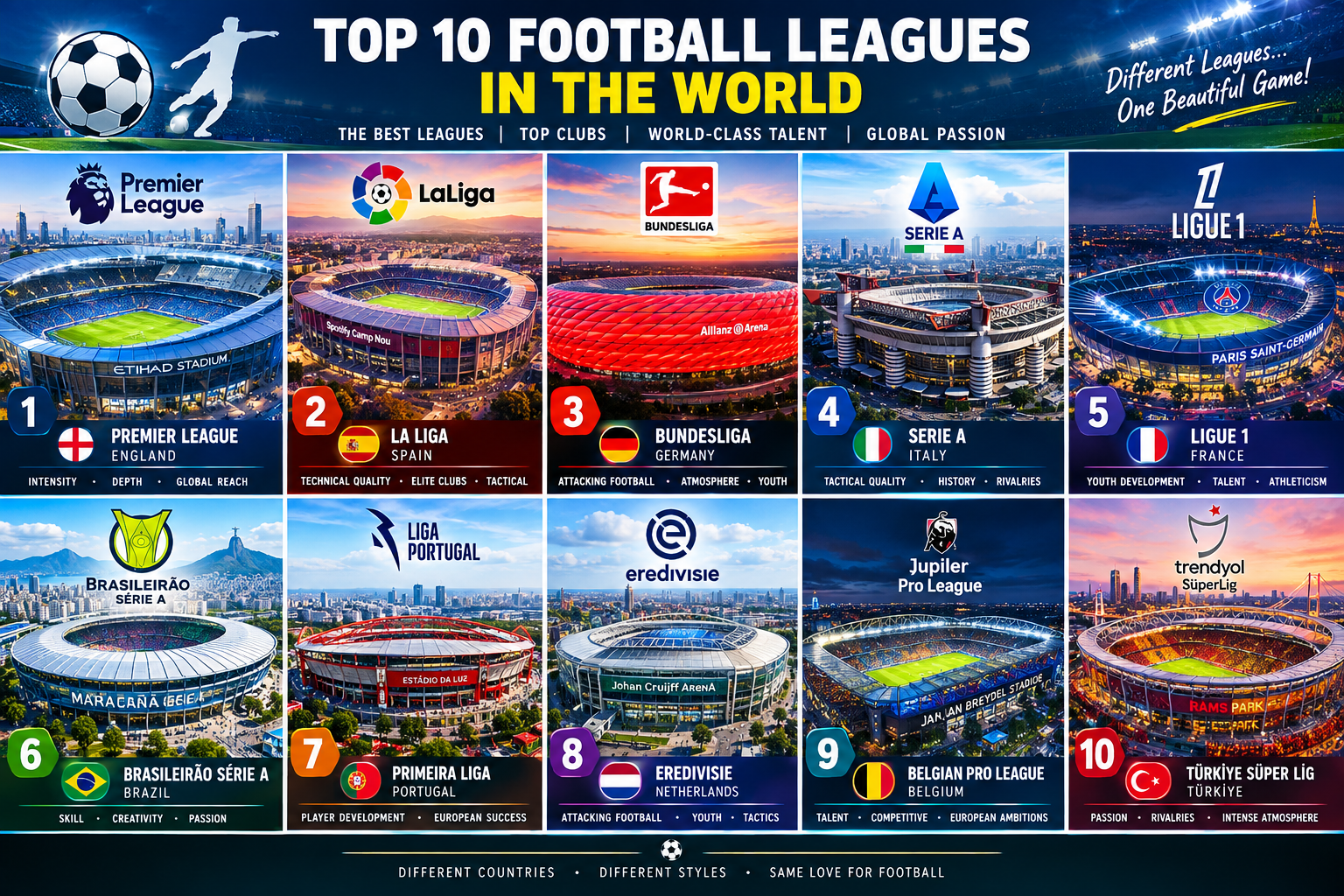
Top 10 Football Leagues in the World in 2026: Complete Guide for Football Fans
Top 10 Football Leagues in the World in 2026: Complete Guide for Football Fans
Football is played in almost every corner of the world, but some domestic leagues consistently attract more attention because of their quality, competitive depth, famous clubs, world-class players, stadiums, finances and success in international competitions.
From England’s high-intensity Premier League to Brazil’s technically gifted Série A and the talent-producing Eredivisie, the world’s leading football leagues offer very different styles of football.
There is no single universally accepted ranking of the “best” football leagues because different ranking systems measure different things. UEFA coefficients, for example, primarily measure clubs’ performances in European competitions, while Opta’s Power Rankings use club-strength ratings. As of 2026, UEFA’s five-year association coefficients place England, Italy, Spain, Germany and France among Europe’s leading associations.
This guide looks at 10 of the world’s most prominent and competitive football leagues, considering sporting quality, club strength, international reputation, competitiveness, player development and global popularity.
Top 10 Football Leagues in the World
| RankFootball LeagueCountryWhat Makes It Stand Out | |||
|---|---|---|---|
| 1 | Premier League | England | Depth, intensity, global reach |
| 2 | La Liga | Spain | Technical quality and elite clubs |
| 3 | Bundesliga | Germany | Atmosphere, attacking football, development |
| 4 | Serie A | Italy | Tactical quality and historic clubs |
| 5 | Ligue 1 | France | Youth development and elite talent |
| 6 | Brasileirão Série A | Brazil | Talent, competition and football culture |
| 7 | Primeira Liga | Portugal | Player development and European success |
| 8 | Eredivisie | Netherlands | Youth development and attacking football |
| 9 | Belgian Pro League | Belgium | Talent development and competitive structure |
| 10 | Turkish Süper Lig | Türkiye | Passion, major clubs and intense atmospheres |
The order is an editorial comparison rather than an official universal ranking. Different methodologies can produce different results.
1. Premier League – England
The Premier League is widely regarded as one of the most commercially powerful and internationally followed football competitions in the world.
Founded in 1992, the English top flight has developed into a global sporting product featuring clubs with enormous international fan bases, highly competitive squads and some of the world’s most recognizable footballers.
UEFA’s current five-year association coefficient ranking has England in first place, reflecting the performances of English clubs in European competitions over the relevant period.
Why the Premier League is so popular
One of the league’s biggest strengths is its depth.
Competition is not limited to a small group of famous clubs. Teams throughout the division can possess substantial financial resources, quality coaching staffs and international players.
The league is also known for:
- Fast-paced football
- Physical intensity
- Large international audiences
- Strong commercial revenues
- Highly competitive matches
- World-class managers
- Deep squads
- Famous stadiums
- Strong academy systems
Clubs such as Manchester City, Liverpool, Manchester United, Arsenal and Chelsea have helped build the league’s worldwide profile.
Tactical diversity
Another interesting feature of the Premier League is the variety of tactical approaches.
Supporters can watch possession-oriented football, aggressive pressing, counter-attacking systems, deep defensive structures and direct attacking football within the same competition.
That tactical variety makes the Premier League particularly interesting for football analysts.
Global influence
The Premier League has also become a major destination for players and coaches from across the world.
Its global television audience and commercial partnerships have made English football influential far beyond England.
For many international football fans, watching the Premier League has become part of the weekly football routine.
2. La Liga – Spain
Spain’s La Liga is one of the most technically respected football competitions in the world.
Spanish football has historically been associated with possession, intelligent movement, technical ability and tactical sophistication.
The league has also produced some of the world’s greatest clubs, including Real Madrid, Barcelona and Atlético Madrid.
UEFA’s five-year association coefficients continue to place Spain among Europe’s leading football nations.
Why La Liga stands out
La Liga is particularly attractive to supporters who enjoy technical football.
Players are often expected to demonstrate:
- Close ball control
- Accurate passing
- Intelligent positioning
- Tactical awareness
- Technical creativity
- Combination play
Spanish clubs have also enjoyed enormous success in European competitions.
Real Madrid and Barcelona
The worldwide reputation of La Liga has been heavily influenced by clubs such as Real Madrid and Barcelona.
Real Madrid’s European history is particularly significant, while Barcelona has developed one of football’s most recognizable playing philosophies.
Atlético Madrid has also demonstrated that success can be achieved through a different tactical approach, combining defensive organization with disciplined counter-attacking football.
Youth development
Spain also has a strong tradition of developing technically gifted players.
Academies emphasize ball control, decision-making and tactical understanding from a young age.
This has contributed to Spain’s reputation as one of the world’s major football-producing nations.
3. Bundesliga – Germany
Germany’s Bundesliga combines high-quality football with some of the strongest supporter cultures in Europe.
The league is famous for its passionate crowds, large stadiums, attacking football and emphasis on developing young players.
Germany currently sits among Europe’s top football associations in UEFA’s coefficient rankings.
What makes the Bundesliga special?
One of the most recognizable features of German football is the atmosphere inside stadiums.
Clubs such as Borussia Dortmund are famous for enormous and passionate home crowds.
The Bundesliga is also known for:
- High attendance
- Fast attacking football
- Pressing
- Youth development
- Strong club structures
- Competitive European teams
- Excellent stadium facilities
Bayern Munich
Bayern Munich has been one of the defining clubs of German football for decades.
Its domestic success and European performances have contributed significantly to Germany’s football reputation.
However, the Bundesliga is not only about Bayern.
Clubs such as Borussia Dortmund, Bayer Leverkusen and RB Leipzig have also become important forces in German and European football.
Development of young players
Germany has built an impressive reputation for developing young talent.
Young players frequently receive opportunities to compete at senior level, helping them gain experience before potentially moving to larger clubs.
4. Serie A – Italy
Italy’s Serie A is one of football’s most historic competitions.
Italian football has traditionally been associated with tactical discipline, defensive organization and intelligent game management.
However, modern Serie A also features sophisticated attacking systems, aggressive pressing and technically strong players.
UEFA’s current five-year coefficient ranking places Italy second among European associations, behind England.
Why Serie A remains important
Serie A features several clubs with enormous historical importance, including:
- Juventus
- AC Milan
- Inter Milan
- AS Roma
- Napoli
- Lazio
These clubs have won domestic championships and European trophies across different eras.
Tactical football
Serie A is particularly attractive to people interested in football tactics.
Managers frequently focus heavily on:
- Defensive structure
- Tactical formations
- Pressing
- Midfield organization
- Positional discipline
- Counter-attacking
- Set pieces
The league’s tactical reputation makes it an interesting competition for analysts and coaches.
Historic stadiums and rivalries
Italian football also has some of the most famous rivalries in Europe.
Derbies such as Inter vs AC Milan and Roma vs Lazio provide enormous cultural and sporting interest.
5. Ligue 1 – France
France’s Ligue 1 is one of the world’s most important talent-producing competitions.
While Paris Saint-Germain has become the league’s most internationally recognized club in the modern era, French football’s influence extends far beyond one team.
UEFA currently ranks France among Europe’s top five associations on its five-year coefficient table.
Why Ligue 1 matters
The French football system has developed a remarkable ability to produce talented young players.
Many players who later become stars in major European leagues begin their professional careers in France.
French clubs are known for developing:
- Fast attackers
- Creative midfielders
- Athletic defenders
- Technically skilled youngsters
- Goalkeepers
- Versatile players
Paris Saint-Germain
PSG has played an important role in increasing Ligue 1’s global visibility.
The club’s international profile, financial resources and major players have attracted huge audiences around the world.
Strong football academies
One of Ligue 1’s greatest strengths is its relationship with youth football.
French academies regularly produce players capable of competing at the highest international level.
This makes Ligue 1 particularly important for football scouts and talent developers.
6. Brasileirão Série A – Brazil
Brazil’s Campeonato Brasileiro Série A, commonly called the Brasileirão, is one of the strongest domestic leagues outside Europe.
Brazil has an extraordinary football culture, and the domestic league reflects that passion.
The competition features clubs with huge supporter bases, historic rivalries and a long tradition of producing elite players.
Why the Brasileirão is special
Brazilian football is famous for:
- Technical skill
- Creativity
- Individual talent
- Attacking football
- Youth development
- Passionate supporters
- Historic clubs
Major clubs include Flamengo, Palmeiras, São Paulo, Corinthians, Santos and Internacional, among many others.
A major talent factory
Brazil has produced generations of football stars who later became global icons.
The country’s football academies continue to develop young players who attract attention from clubs in Europe and other regions.
Competitive environment
Unlike some leagues where a small group of clubs dominates for long periods, Brazilian football can produce different championship contenders over time.
The large number of historic clubs creates an enormous domestic football ecosystem.
7. Primeira Liga – Portugal
Portugal’s Primeira Liga is one of Europe’s most important football development leagues.
The competition is particularly well known for producing talented players who eventually move to larger European leagues.
Portugal’s football clubs have also made a significant impact in European competitions.
Major Portuguese clubs
The league’s traditional powerhouses include:
- Benfica
- Porto
- Sporting CP
- Braga
These clubs have developed strong domestic and international identities.
Excellent player development
Portugal has become an important destination for young football talent.
Clubs often develop players before transferring them to larger European leagues.
This creates an interesting combination of:
Youth development + tactical education + European competition.
European success
Portuguese clubs have historically performed well in European competitions.
Portugal’s position among Europe’s leading football associations demonstrates the importance of its clubs in continental football.
8. Eredivisie – Netherlands
The Eredivisie is one of Europe’s most famous talent-development leagues.
Dutch football has had an enormous influence on the tactical evolution of the sport.
The Netherlands is associated with attacking football, technical development and positional intelligence.
Famous Eredivisie clubs
The competition includes major clubs such as:
- Ajax
- PSV Eindhoven
- Feyenoord
- AZ Alkmaar
- FC Twente
Ajax and youth development
Ajax is particularly famous for its academy system.
The club has produced numerous internationally recognized footballers and helped establish a philosophy based on technical ability and tactical intelligence.
Dutch football philosophy
The Eredivisie is often associated with:
- Possession football
- Attacking systems
- Technical players
- Youth development
- Tactical flexibility
- Intelligent movement
The league can therefore be particularly interesting for supporters who enjoy watching emerging talent.
9. Belgian Pro League – Belgium
Belgium’s top division has become an increasingly important part of European football’s talent-development network.
The Belgian Pro League provides opportunities for young players while also featuring established clubs with European ambitions.
UEFA’s five-year association coefficient rankings place Belgium among Europe’s stronger football associations.
Major Belgian clubs
The league features clubs such as:
- Club Brugge
- Anderlecht
- Genk
- Standard Liège
- Gent
A pathway for young players
Belgian clubs have become known for identifying promising players and giving them competitive senior football.
This can make the league particularly interesting for scouts and fans who enjoy discovering emerging talent before it reaches Europe’s biggest competitions.
European ambitions
Belgian clubs regularly compete in UEFA competitions, giving players valuable exposure to different tactical styles and stronger opposition.
10. Turkish Süper Lig – Türkiye
The Turkish Süper Lig completes our list of 10 major football leagues to watch.
Turkish football is famous for passionate supporters, intense rivalries and enormous interest in the country’s biggest clubs.
The league’s leading clubs include:
- Galatasaray
- Fenerbahçe
- Beşiktaş
- Trabzonspor
Famous football atmosphere
Turkish football stadiums can generate some of the most intense atmospheres in European football.
The rivalry between Istanbul’s major clubs is particularly important to the country’s football culture.
Growing international profile
The league has attracted established international players and coaches over the years.
It also provides a competitive environment for players seeking European experience.
How Are the Best Football Leagues Ranked?
There is no single formula for determining the world’s best football league.
Different organizations use different methodologies.1. UEFA coefficient rankings
UEFA coefficients measure the performance of clubs representing European associations in UEFA competitions.
This makes them particularly useful when comparing European leagues based on continental performance.
As of the current UEFA five-year association coefficient ranking, England, Italy, Spain, Germany and France occupy the first five positions.
However, UEFA rankings cannot directly measure leagues outside UEFA, such as Brazil’s Série A.
2. Club strength
Another approach is to examine how strong individual clubs are.
A league with several elite teams may have greater depth than one dominated by only one or two clubs.
This is why factors such as:
- European results
- International players
- Squad quality
- Transfer spending
- Club performance
- Coaching quality
can be useful when comparing competitions.
3. Player development
A league should not necessarily be judged only by the number of famous players currently playing in it.
Some competitions are particularly important because they develop future stars.
The Eredivisie, Ligue 1, Primeira Liga, Belgian Pro League and Brazilian Série A are especially interesting from this perspective.
4. Competitiveness
Competitiveness is another important factor.
Football fans may look at:
- Number of title contenders
- Points gaps
- European qualification races
- Relegation battles
- Cup performances
- Strength of mid-table teams
A league with several competitive teams can provide excitement throughout the season.
Top 5 European Football Leagues
The traditional “Big Five” European leagues are:
1. Premier League
England
2. La Liga
Spain
3. Bundesliga
Germany
4. Serie A
Italy
5. Ligue 1
France
Opta’s July 2026 analysis also identified these five as the traditional top five European leagues, while noting that its Power Rankings methodology can produce a different ordering from UEFA’s coefficients.
This is an important distinction: there is no single universally accepted ranking system.
Which Football Leagues Produce the Most Young Talent?
Several leagues stand out as important development environments.
France
French football has an extensive youth-development system and has produced generations of elite players.
Netherlands
The Eredivisie has a long-standing reputation for technical and tactical development.
Portugal
Portuguese clubs have become highly effective at developing and transferring young talent.
Brazil
Brazil continues to produce technically gifted players from academies across the country.
Belgium
Belgian clubs have increasingly developed young players for domestic and international markets.
Why Football Fans Should Follow Multiple Leagues
Following only one league can limit your understanding of world football.
Watching different competitions allows supporters to see different tactical philosophies and football cultures.
For example:
Premier League: intensity and depth
La Liga: technical quality and tactical possession
Bundesliga: attacking football and pressing
Serie A: tactical organization
Ligue 1: athleticism and young talent
Brasileirão: creativity and technical skill
Primeira Liga: player development
Eredivisie: attacking football and youth development
Belgian Pro League: emerging talent
Süper Lig: rivalry and atmosphere
Top Football Leagues for Football Analysis
Football analysts often look beyond league reputation.
A league can be evaluated using statistical indicators such as:
- Goals per game
- Expected goals (xG)
- Expected goals against (xGA)
- Shots per match
- Possession
- Progressive passes
- Pressing intensity
- Defensive actions
- Set-piece goals
- Home and away performance
- Squad age
- Transfer values
These statistics can reveal differences between leagues that are not obvious from watching individual matches.
For example, a league might have fewer famous players but still have strong tactical depth.
Best Football Leagues for Watching Goals
Fans who enjoy attacking football may be attracted to leagues with high-scoring matches.
However, goal averages change from season to season.
Rather than assuming that one league is always the highest-scoring competition, it is better to examine current-season statistics.
Important metrics include:
Goals per match = Total goals ÷ Matches played
You can also examine expected goals to understand whether high-scoring results are supported by the quality of chances being created.
Best Football Leagues for Young Players
If your main interest is discovering future stars, consider following:
- Eredivisie
- Ligue 1
- Primeira Liga
- Brasileirão Série A
- Belgian Pro League
These competitions have strong connections to player development and talent recruitment.
Of course, individual clubs can differ significantly within the same league.
Best Football Leagues for Tactical Football
For tactical analysis, several competitions are particularly interesting.
Serie A
Known historically for tactical organization and defensive strategy.
La Liga
Strong tradition of positional football and technical play.
Bundesliga
Strong emphasis on pressing, transitions and attacking structures.
Premier League
A mixture of tactical systems because of the variety of managers and playing styles.
Eredivisie
Interesting for studying possession, attacking structures and youth development.
Why the Premier League Has Such a Huge Global Audience
The Premier League’s popularity is influenced by several factors.
Global stars
The competition attracts famous players from many countries.
Famous clubs
Manchester United, Liverpool, Arsenal, Chelsea and Manchester City have huge international followings.
Financial strength
The league’s commercial ecosystem allows many clubs to invest heavily in squads, facilities and coaching.
Competitive matches
The strength of many teams means that matches can be difficult to predict.
Worldwide broadcasting
Premier League matches are distributed internationally, helping the competition maintain a large global audience.
Football Leagues Outside Europe Deserve Attention
When discussing the world’s top football leagues, it is easy to focus exclusively on Europe.
However, football outside Europe is extremely important.
Brazil
Brazil’s domestic football system is one of the world’s largest talent-producing environments.
Argentina
Argentina has a rich football culture and an impressive history of developing players.
United States
Major League Soccer continues to grow commercially and has developed its own football ecosystem.
Saudi Arabia
The Saudi Pro League has attracted increased international attention through investment and the arrival of prominent players.
Mexico
Liga MX has a large football audience and strong domestic competition.
These leagues should not automatically be ranked below European competitions simply because UEFA’s coefficient system does not measure them.
Top 10 Football Leagues: Final Overview
The modern football landscape is much broader than a simple ranking.
The Premier League, La Liga, Bundesliga, Serie A and Ligue 1 form Europe’s traditional elite group and remain major forces in international club football. UEFA’s current five-year association rankings support their position among Europe’s leading associations.
Meanwhile, competitions such as the Brasileirão, Primeira Liga, Eredivisie, Belgian Pro League and Turkish Süper Lig offer their own strengths, from youth development and technical football to passionate supporters and European competition.
The exact order depends on the criteria being used.
If you measure European club performance, UEFA coefficients are particularly relevant. If you measure individual club strength, other ranking systems may produce different results. Opta’s 2026 analysis, for example, uses average club-strength ratings and produced a different ordering among some of Europe’s leading leagues.
Frequently Asked Questions About the World’s Top Football Leagues
Which is the best football league in the world?
There is no universally accepted answer because different ranking systems measure different aspects of football quality. The Premier League is currently first in UEFA’s five-year association coefficient ranking among European associations, while other methodologies can produce different results.
What are the Big Five football leagues?
The traditional Big Five are the Premier League, La Liga, Bundesliga, Serie A and Ligue 1.
Which football league is the most popular?
The Premier League is one of the world’s most internationally followed domestic football competitions, with a particularly large global audience.
Which league is best for developing young players?
Several leagues have strong youth-development reputations, including Ligue 1, Eredivisie, Primeira Liga, Brasileirão Série A and the Belgian Pro League.
Is Brazilian Série A one of the best leagues in the world?
The Brasileirão is one of the world’s major domestic competitions and an important source of football talent. However, comparing it directly with European leagues depends on the criteria used.
Which football leagues are included in UEFA rankings?
UEFA’s coefficient rankings cover European football associations and their clubs participating in UEFA competitions. They therefore do not directly rank domestic leagues from countries outside UEFA.
Conclusion
The world’s football landscape is filled with outstanding competitions.
The Premier League offers enormous depth and global reach. La Liga is renowned for technical football and elite clubs. The Bundesliga combines attacking football with outstanding supporter culture, while Serie A remains one of the world’s most tactically interesting competitions. Ligue 1 is an important source of young talent.
Beyond Europe’s traditional elite, the Brasileirão, Primeira Liga, Eredivisie, Belgian Pro League and Turkish Süper Lig provide exciting football, strong clubs and important pathways for emerging players.
For football fans, the best approach is not necessarily to watch only one competition. Following multiple leagues provides a broader understanding of different playing styles, tactical systems, football cultures and player-development models