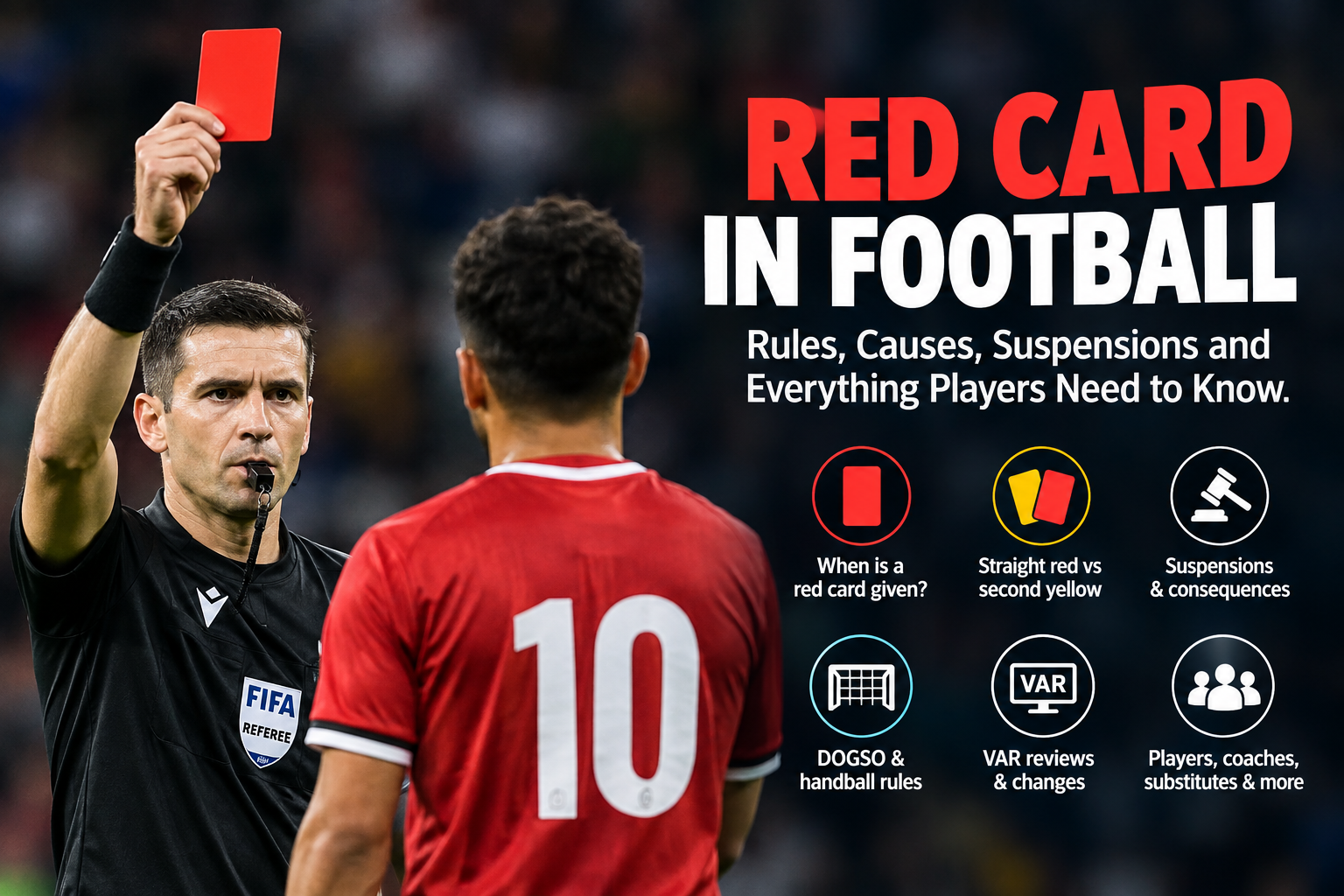
Red Card in Football: Rules, Causes, Suspensions and Everything Players Need to Know
Red Card in Football: Rules, Causes, Suspensions and Everything Players Need to Know
A red card in football is one of the most serious disciplinary sanctions a referee can give to a player, substitute or substituted player. It means the individual has been sent off and cannot continue participating in the match.
A red card can dramatically change a football match. A team that loses a player normally has to continue with fewer players, forcing the coach to make tactical adjustments while opponents may gain additional space and possession.
But when exactly is a red card given? What is the difference between a straight red card and a second yellow card? Can a goalkeeper receive a red card? What happens after a player is sent off? And how many matches can a player miss because of a red card?
This complete guide explains the red card rules in football, common causes of sending-offs, the difference between red and yellow cards, suspensions, VAR reviews, DOGSO situations and other important rules players and football fans should understand.
What Is a Red Card in Football?
A red card is the official signal used by a referee to indicate that a player or another permitted team participant has been sent off.
Under Law 12 of the Laws of the Game, the red card communicates a sending-off. Players, substitutes and substituted players can be shown a red card when they commit a sending-off offence.
Once a player is sent off:
- They must leave the vicinity of the field and technical area.
- They cannot continue playing.
- They cannot be replaced by another player.
- Their team normally continues the match with one fewer player.
- They may receive an additional suspension under the competition’s disciplinary regulations.
The referee can also take disciplinary action for certain offences committed before the match, during the match and after the match, within the authority provided by the Laws.
Why Do Referees Give Red Cards?
Red cards are designed to deal with serious misconduct and offences that threaten the safety, fairness or integrity of the game.
The most common reasons include:
- Serious foul play
- Violent conduct
- Denying a goal or obvious goal-scoring opportunity
- Certain deliberate handball offences
- Biting or spitting at another person
- Offensive, insulting or abusive language or actions
- Receiving a second yellow card
- Certain serious misconduct involving substitutes or team officials
- Other sending-off offences specified by the Laws and applicable competition regulations
IFAB Law 12 specifically identifies serious foul play, violent conduct, certain DOGSO offences, biting or spitting, offensive or abusive language or actions, and a second caution in the same match among sending-off offences.
1. Serious Foul Play
Serious foul play is one of the most familiar reasons for a straight red card.
A tackle or challenge can become serious foul play when it:
- Endangers the safety of an opponent;
- Uses excessive force; or
- Involves excessive force or brutality while challenging for the ball.
For example, a player who makes a dangerous lunge with excessive force and puts an opponent at serious risk can be sent off.
The referee considers the nature and severity of the challenge rather than simply looking at whether contact occurred.
A normal foul does not automatically become a red-card offence.
The Laws distinguish between:
Careless: A lack of attention or precaution. Normally no disciplinary sanction.
Reckless: The player disregards the danger or consequences for an opponent. A yellow card is normally required.
Excessive force: The player exceeds the necessary use of force and/or endangers the safety of an opponent. This requires a red card.
Examples of Serious Foul Play
A player may be at risk of a red card for:
- A high-force tackle that endangers an opponent.
- A lunging challenge with excessive force.
- A challenge using one or both legs with excessive force.
- A challenge that seriously threatens an opponent’s safety.
The referee must judge the individual incident according to the Laws.
2. Violent Conduct
Violent conduct is another major reason for a straight red card.
Unlike serious foul play, violent conduct generally involves excessive force or brutality when the player is not challenging for the ball.
It can happen against:
- An opponent
- A teammate
- A team official
- A match official
- A spectator
- Another person
Contact does not always have to occur for violent conduct to exist.
For example, attempting to strike someone with excessive force can constitute violent conduct even if the intended target is not actually hit.
A deliberate strike to the head or face with the hand or arm, when not challenging for the ball, is also specifically addressed by Law 12.
3. Denying an Obvious Goal-Scoring Opportunity — DOGSO
Football fans often hear commentators use the term DOGSO.
DOGSO means:
Denying an Obvious Goal-Scoring Opportunity.
A defender can receive a red card when they commit an offence that denies an opponent an obvious opportunity to score, depending on the circumstances.
Referees consider factors including:
- The distance between the offence and the goal
- The general direction of play
- Whether the attacker was likely to keep or gain control of the ball
- The location and number of defenders and attackers
This is why not every foul on the last defender automatically results in a red card.
The circumstances of the attack matter.
4. DOGSO Inside the Penalty Area
One of the most misunderstood red-card situations occurs inside the penalty area.
Suppose a defender commits an offence inside their own penalty area and the referee awards a penalty kick because the offence denied an obvious goal-scoring opportunity.
If the defender was genuinely attempting to play the ball or challenging for the ball, the punishment can be a yellow card rather than a red card.
However, if the offence involves circumstances such as:
- Holding
- Pulling
- Pushing
- No possibility of playing the ball
- Another offence outside the relevant “attempt to play the ball” exception
the player can be sent off.
This is sometimes informally described as the “double jeopardy” rule because a player may avoid a red card in certain penalty-area DOGSO situations when the conditions for the exception are met.
5. Deliberate Handball to Stop a Goal
Handball can also lead to a red card.
A player is sent off when they deny the opposing team a goal or obvious goal-scoring opportunity through a deliberate handball offence, except for a goalkeeper within their own penalty area.
A non-deliberate handball outside the player’s own penalty area that denies a goal or obvious goal-scoring opportunity can also result in a sending-off.
This is different from ordinary handball, where the disciplinary punishment can be different depending on the circumstances.
6. Biting or Spitting
Biting or spitting at another person is a sending-off offence.
These incidents are treated very seriously because they involve conduct outside the normal physical contest for the ball.
A player can be sent off for biting or spitting at:
- An opponent
- A teammate
- A team official
- A match official
- Another person
The Laws specifically list biting and spitting among sending-off offences.
7. Offensive, Insulting or Abusive Language
A player can also receive a red card for using offensive, insulting or abusive language and/or actions.
Football is a highly emotional sport, but players are expected to control their behaviour toward opponents, officials and others involved in the match.
Not every complaint or disagreement results in a red card. The referee evaluates the nature and seriousness of the language or action.
8. Two Yellow Cards Equal a Red Card
A player does not always receive a straight red card.
A player can be sent off after receiving two yellow cards in the same match.
The sequence is:
First yellow card → Second yellow card → Red card → Player sent off
The player then cannot continue playing and cannot be replaced.
The second caution may result from another foul, dissent, delaying the restart, unsporting behaviour or another cautionable offence.
The Laws specifically list receiving a second caution in the same match as a sending-off offence.
Straight Red Card vs Second Yellow Card
There is an important distinction between the two.
| Situation | Result |
|---|---|
| Serious foul play | Straight red |
| Violent conduct | Straight red |
| Certain DOGSO offences | Straight red |
| Deliberate handball denying a goal/DOGSO | Straight red |
| Biting or spitting | Straight red |
| Offensive/abusive language or actions | Straight red |
| Second yellow card | Red card and sending-off |
The consequences during the match are broadly the same: the player is sent off and cannot continue.
However, competition disciplinary regulations may distinguish between different types of offences when determining subsequent suspension.
What Happens to the Team After a Red Card?
When a player is sent off, the team normally continues with one fewer player.
For example:
Before red card: 11 players
After red card: 10 players
The team cannot simply send on another player to replace the dismissed player.
This can have a major tactical impact.
The coach may respond by:
- Changing formation
- Moving midfielders deeper
- Removing an attacking player through an available substitution
- Defending more compactly
- Playing on the counterattack
- Protecting a narrow lead
The tactical response depends on the score, time remaining, opponent and competition circumstances.
Can a Team Have Two Red Cards?
Yes.
If two players from the same team are sent off, the team normally continues with:
9 players against 11.
Further dismissals can reduce the number of players even more, although the Laws and competition regulations contain provisions governing the minimum number of players required for a match to continue.
Multiple red cards can therefore transform the tactical nature of a match.
Can a Goalkeeper Receive a Red Card?
Yes.
A goalkeeper is subject to the same disciplinary Laws as other players.
A goalkeeper can receive a red card for offences such as:
- Serious foul play
- Violent conduct
- Certain DOGSO offences
- Deliberate handball offences that meet the sending-off criteria
- A second yellow card
- Other sending-off offences
The major difference is what happens tactically after the goalkeeper is dismissed.
If the team has substitutions available and the competition regulations allow it, the coach may use a substitute goalkeeper, with another player leaving the field.
Alternatively, an outfield player may have to become goalkeeper.
Does a Red Card Always Mean a Penalty?
No.
A red card and a penalty kick are two different decisions.
A player may receive a red card:
- In midfield
- Near the halfway line
- Outside the penalty area
- Inside the penalty area
- For violent conduct away from the ball
A penalty kick is awarded only when the Laws’ conditions for a penalty are met.
Therefore:
Red card ≠ automatic penalty.
However, certain DOGSO offences inside the penalty area can result in both a penalty kick and a red card.
What Happens When VAR Is Available?
In competitions using VAR, certain possible red-card incidents can be reviewed.
VAR can help the referee assess incidents such as:
- Possible serious foul play
- Possible violent conduct
- Certain DOGSO situations
- Other reviewable sending-off incidents
The referee remains responsible for the final decision.
A VAR review can result in a red card being confirmed, changed or overturned, depending on the evidence and applicable protocol.
VAR does not mean every foul or yellow card is automatically reviewed.
Can a Red Card Be Changed After VAR?
Yes.
If the referee initially gives a red card and a VAR review determines that the sending-off decision was incorrect, the referee can change the decision in accordance with the VAR protocol.
Likewise, an incident that was initially punished with a yellow card can be reviewed when it falls within the applicable review category and changed to a red card.
The purpose is to correct a clear and obvious error or serious missed incident within VAR’s permitted areas.
Can a Player Be Sent Off After the Final Whistle?
The referee’s disciplinary authority extends beyond the period when the ball is simply in play.
Under Law 12, the referee has authority to take disciplinary action from the pre-match inspection until leaving the field after the match, including during a penalty shoot-out.
This means serious misconduct around the end of a match can still have disciplinary consequences.
Can a Substitute Receive a Red Card?
Yes.
A substitute can be shown a red card.
A substituted player can also be sent off.
This is important because disciplinary control does not apply only to the 11 players currently on the pitch.
Team participants in the technical area are also subject to disciplinary rules.
Can a Coach Receive a Red Card?
Yes.
Team officials, including coaches, can be disciplined for serious misconduct.
Examples can include:
- Aggressive behaviour
- Physical confrontation
- Offensive, insulting or abusive language or actions
- Entering the field to confront an official
- Entering the opposing technical area aggressively
- Violent conduct
- Deliberately throwing or kicking an object onto the field
- Other serious misconduct listed under the Laws
The exact disciplinary response depends on the offence and circumstances.
What Is a Red Card Suspension?
A red card suspension is a disciplinary ban that prevents a player from participating in one or more subsequent matches.
However, there is no single universal number of matches for every red card.
The suspension depends on:
- The competition
- The governing body’s disciplinary regulations
- The nature of the offence
- Whether the dismissal resulted from a second yellow card or straight red
- The player’s disciplinary record where relevant
- Any additional disciplinary proceedings
For this reason, saying that “every red card means a three-match ban” is inaccurate.
The suspension must be checked against the regulations governing the particular competition.
How Long Is a Red Card Suspension?
There is no universal suspension length that applies to every football competition.
A competition may prescribe different sanctions for:
- Second-yellow-card dismissals
- Serious foul play
- Violent conduct
- Offensive or abusive behaviour
- DOGSO
- Other serious misconduct
In some competitions, particularly serious offences can lead to longer bans than ordinary dismissals.
Therefore, players, coaches and fans should consult the relevant competition’s disciplinary regulations or official disciplinary decision.
Does a Red Card Carry Over Into the Next Competition?
This depends on the regulations of the competition and governing body.
A suspension may sometimes have consequences beyond the competition in which the offence occurred, while other sanctions can be competition-specific.
Therefore, players should not assume that a suspension automatically disappears when a different tournament begins.
The applicable disciplinary regulations determine how the sanction is served.
Red Cards and Football Betting
Red cards can also have a significant effect on football betting markets.
For example, a red card can change:
- Match odds
- Over/under goal markets
- Both teams to score markets
- Asian handicap markets
- Correct-score markets
- Live betting prices
However, a red card does not guarantee a particular match outcome.
A team playing with 10 players may change its tactical approach, while the team with a numerical advantage may struggle to break down a defensive block.
Anyone analysing football matches should treat a red card as one match factor among many, rather than assuming it automatically determines the result.
How Players Can Avoid Red Cards
Players can reduce their risk of being sent off by improving discipline and decision-making.
1. Control your tackles
Avoid unnecessary challenges when you are beaten or out of position.
2. Understand the referee’s approach
Players should quickly learn how the referee is managing challenges and dissent.
3. Avoid retaliation
If an opponent commits a foul, do not respond with violence.
4. Control your emotions
Arguing aggressively with officials can result in disciplinary action.
5. Do not deliberately stop an obvious attack
Professional fouls can carry significant disciplinary consequences.
6. Be careful after receiving a yellow card
A player already on a yellow card must be particularly disciplined.
7. Avoid unnecessary dissent
Complaining repeatedly can increase the likelihood of another caution.
8. Respect opponents
Provocation, confrontation and violent reactions can turn an ordinary incident into a serious disciplinary problem.
Why Red Cards Matter Tactically
A red card does more than remove one player.
It changes the structure of the entire team.
A coach may have to sacrifice an attacker to introduce a defender or goalkeeper. Midfielders may drop deeper, full-backs may become more conservative and forwards may be isolated.
The team with numerical superiority may also change its approach.
Instead of attacking with maximum risk, it may:
- Keep possession
- Move the ball from side to side
- Stretch the defensive shape
- Create overloads
- Attack spaces between defenders
This is why a red card can completely change the character of a football match.
Common Misunderstandings About Red Cards
Myth 1: Every last-man foul is a red card
Not necessarily.
The referee must assess whether the offence denied an obvious goal-scoring opportunity and consider the relevant DOGSO criteria.
Myth 2: Every red card means three matches
Incorrect.
Suspension lengths depend on the relevant competition’s disciplinary regulations and the offence.
Myth 3: A red card automatically means a penalty
Incorrect.
The red-card decision and penalty-kick decision are separate.
Myth 4: Only players on the pitch can receive red cards
Incorrect.
Substitutes, substituted players and team officials can also face disciplinary sanctions.
Myth 5: A goalkeeper cannot be sent off
Incorrect.
Goalkeepers can receive red cards like other players.
Myth 6: VAR makes every red card automatic
Incorrect.
VAR operates only within the review categories and protocols applicable to the competition.
Red Card vs Yellow Card
The easiest way to understand the difference is to think of a yellow card as a caution and a red card as a sending-off.
| Feature | Yellow Card 🟨 | Red Card 🔴 |
|---|---|---|
| Meaning | Caution | Sending-off |
| Player can continue? | Yes | No |
| Player leaves field? | No | Yes |
| Can player be replaced? | Not applicable | No |
| Can two yellows result in red? | Yes | Already sent off |
| Possible future suspension? | Depends on competition/accumulation rules | Often, depending on regulations |
What Players Should Remember About Red Cards
Every football player should understand the most important principles:
A red card means you are sent off.
You cannot return to the match.
Your team normally continues with one fewer player.
You cannot be directly replaced after being sent off.
Two yellow cards in the same match result in a sending-off.
Serious foul play and violent conduct can lead to a straight red.
Certain DOGSO and handball offences can result in a red card.
A red card may lead to a suspension under competition disciplinary regulations.
The exact suspension depends on the applicable rules.
Frequently Asked Questions About Red Cards in Football
What does a red card mean in football?
A red card means a player, substitute or substituted player has been sent off. They must leave the vicinity of the field and technical area and cannot continue participating in the match.
Can a player come back after a red card?
No. A player who has been sent off cannot return to the match.
Can another player replace a red-carded player?
No. The dismissed player cannot be directly replaced, so the team normally continues with one fewer player.
How many red cards can a football team get?
A team can receive multiple red cards, subject to the Laws concerning the minimum number of players required for a match to continue.
Can a player receive a red card without first receiving a yellow card?
Yes. Serious foul play, violent conduct and other sending-off offences can result in a straight red card.
Does two yellow cards mean a red card?
Yes. A player who receives a second caution in the same match is sent off.
Can a goalkeeper receive a red card?
Yes. Goalkeepers are subject to the Laws and can be sent off for serious offences.
Does a red card always result in a suspension?
A red card can lead to a subsequent suspension, but the exact punishment depends on the disciplinary regulations governing the competition and the nature of the offence.
Can VAR overturn a red card?
In competitions using VAR, eligible sending-off decisions can be reviewed under the applicable VAR protocol.
Can a substitute receive a red card?
Yes. Substitutes and substituted players can also be shown red cards for sending-off offences.
Final Thoughts
A red card in football is much more than a referee simply showing a red piece of plastic. It is a serious disciplinary decision that can affect the player, the team, the tactics and potentially subsequent matches.
Players need to understand the difference between careless, reckless and excessive challenges, while coaches must prepare for the tactical consequences of playing with fewer players.
The most common routes to a red card include serious foul play, violent conduct, certain DOGSO offences, certain handball offences, biting or spitting, offensive or abusive behaviour and receiving a second yellow card.