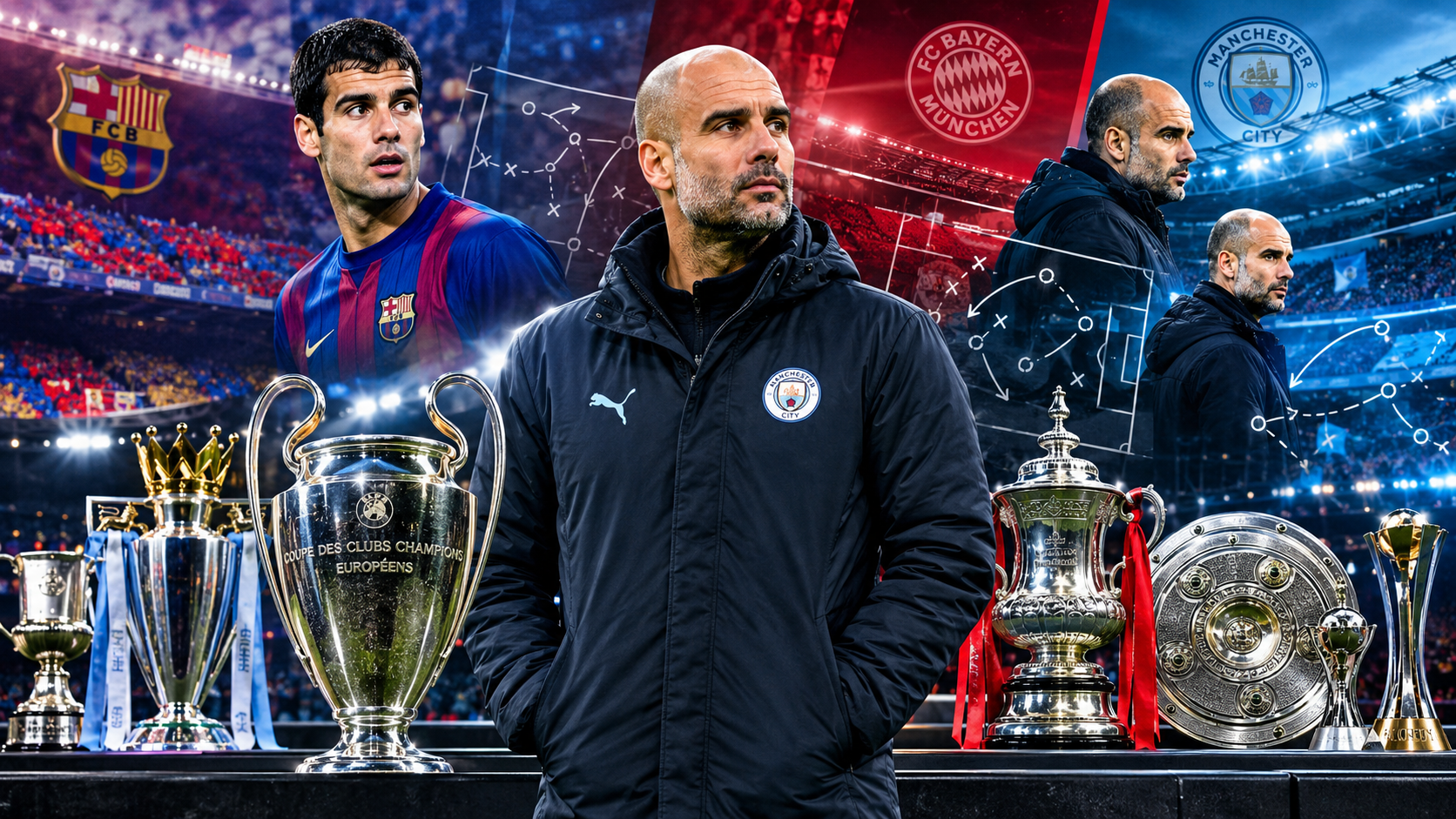
Pep Guardiola Legacy as a Player and Coach: Teams, Trophies, Records and Football Philosophy
Pep Guardiola Legacy as a Player and Coach: Teams, Trophies, Records and Football Philosophy
Pep Guardiola is one of the most influential figures in modern football. His career is remarkable because he built an impressive legacy both as a professional footballer and as a manager.
As a player, Guardiola was an intelligent deep-lying midfielder who became an important part of Johan Cruyff’s famous Barcelona “Dream Team.” As a coach, he transformed Barcelona, Bayern Munich and Manchester City with his possession-based football, positional play, pressing and tactical innovation.
From winning the European Cup as a player to lifting the UEFA Champions League as a manager, Guardiola’s career has been defined by trophies, tactical evolution and a lasting influence on how elite football is played.
By the end of his Manchester City tenure, Guardiola had won 20 trophies with the English club, including six Premier League titles, three FA Cups, five League Cups, three Community Shields, one Champions League, one UEFA Super Cup and one FIFA Club World Cup.
Pep Guardiola Quick Facts
| Category | Details |
|---|---|
| Full name | Josep Guardiola Sala |
| Born | 18 January 1971 |
| Nationality | Spanish |
| Main playing position | Defensive/deep-lying midfielder |
| Famous playing club | Barcelona |
| First major coaching role | Barcelona B |
| Barcelona manager | 2008–2012 |
| Bayern Munich manager | 2013–2016 |
| Manchester City manager | 2016–2026 |
| Barcelona trophies as manager | 14 |
| Bayern Munich trophies as manager | 7 |
| Manchester City trophies | 20 |
| Champions League titles as manager | 3 |
| Major playing achievement | European Cup with Barcelona |
| International playing achievement | Olympic gold with Spain |
Who Is Pep Guardiola?
Pep Guardiola is a Spanish football manager and former professional midfielder whose career has been closely associated with possession football, positional play and tactical innovation.
He was born in Santpedor, Catalonia, on 18 January 1971 and joined Barcelona’s youth system before becoming a first-team player.
Guardiola made his Barcelona first-team debut during the 1990/91 season. He eventually became the team’s number four and played a central role in Johan Cruyff’s influential Barcelona side. Barcelona records describe him as a technically gifted midfielder with an exceptional understanding of the game.
His playing education under Cruyff became particularly important later because many principles Guardiola learned as a player became central to his own coaching philosophy.
Pep Guardiola’s Legacy as a Player
Before becoming one of football’s most celebrated managers, Guardiola enjoyed a highly successful playing career.
He was not primarily known for scoring goals. Instead, his importance came from controlling the game from midfield.
His strengths included:
- Passing accuracy
- Tactical intelligence
- Positioning
- Game control
- Vision
- Ball retention
- Reading the opposition
- Controlling tempo
- Building attacks from deep
He was essentially a midfield organiser.
Rather than relying on physical power, Guardiola used positioning and technique to influence matches.
Guardiola at Barcelona
Guardiola spent the majority of his playing career at Barcelona.
According to FC Barcelona’s official records, he played 479 matches and scored 16 goals for the club between 1990 and 2001.
His Barcelona career coincided with one of the most important periods in the club’s history.
He played alongside legendary footballers including:
- Ronald Koeman
- Michael Laudrup
- Romário
- Hristo Stoichkov
- Luis Enrique
- Rivaldo
- Luís Figo
- Carles Busquets
- José Mari Bakero
Most importantly, he played under Johan Cruyff.
Cruyff’s ideas would later become a major influence on Guardiola’s managerial philosophy.
Teams Pep Guardiola Played For
Guardiola’s professional playing career included several clubs.
Barcelona
1990–2001
This was the defining period of his playing career.
Brescia
2001–2002
After leaving Barcelona, Guardiola moved to Italy and played for Brescia.
Roma
2002
He had a brief spell with Roma.
Al-Ahli
2003–2005
Guardiola continued his playing career in Qatar.
Dorados de Sinaloa
2005–2006
He finished his professional playing career in Mexico.
UEFA lists Barcelona, Brescia, Roma, Al-Ahli and Dorados de Sinaloa among the clubs of his playing career.
Pep Guardiola’s Trophies as a Player
Guardiola won numerous trophies during his Barcelona playing career.
According to FC Barcelona’s official records, his honours included:
| Trophy | Titles |
|---|---|
| La Liga | 6 |
| Copa del Rey | 2 |
| Spanish Super Cup | 4 |
| European Cup | 1 |
| UEFA Cup Winners’ Cup | 1 |
| European Super Cup | 2 |
| Catalan/Regional honours | Several |
The biggest European achievement was winning the 1991/92 European Cup with Barcelona.
That victory was particularly significant because Guardiola would eventually win the same competition as a manager.
Guardiola and the 1992 European Cup
The 1992 European Cup final was played at Wembley, where Barcelona faced Sampdoria.
Ronald Koeman scored the decisive goal in extra time, giving Barcelona their first European Cup.
Guardiola was part of the team.
More than three decades later, Guardiola would return to the Champions League stage as a manager and win Europe’s premier club competition with Barcelona and Manchester City.
That gives his career a unique connection between the European Cup era and the modern Champions League era.
Guardiola’s International Career
Guardiola also represented Spain.
He won Olympic gold with Spain at the 1992 Barcelona Olympic Games. UEFA records that he earned 47 international caps during his playing career.
The Olympic gold medal was one of the highlights of his international career.
The Beginning of Guardiola’s Coaching Career
After retiring from professional football, Guardiola moved into management.
His first major coaching opportunity came with Barcelona B in 2007.
The move was significant because it allowed Guardiola to begin developing his own tactical ideas.
He helped the reserve side achieve promotion before receiving the opportunity to manage Barcelona’s first team.
In 2008, Barcelona appointed Guardiola as first-team manager.
It proved to be one of the most important managerial appointments in modern football.
Pep Guardiola at Barcelona
2008–2012
Guardiola’s four seasons as Barcelona manager established his reputation at the highest level.
During his time in charge, Barcelona won 14 trophies.
According to FC Barcelona, those trophies included:
- 3 La Liga titles
- 2 Copa del Rey titles
- 3 Spanish Super Cups
- 2 UEFA Champions League titles
- 2 UEFA Super Cups
- 2 FIFA Club World Cups
His Barcelona team became famous for a style based on possession, movement, pressing and positional discipline.
Guardiola’s Historic First Season at Barcelona
The 2008/09 season immediately changed Guardiola’s reputation.
Barcelona won:
- La Liga
- Copa del Rey
- UEFA Champions League
That meant Guardiola won the treble in his first season as Barcelona manager.
Barcelona’s official history records the 2008/09 treble as a landmark achievement and notes that it was the first time a Spanish club had completed that particular treble.
The Champions League final was played in Rome, where Barcelona defeated Manchester United 2–0.
Samuel Eto’o and Lionel Messi scored the goals.
Barcelona’s Six-Trophy Year
Guardiola’s Barcelona reached another extraordinary level in 2009.
After winning the treble, Barcelona also won:
- Spanish Super Cup
- UEFA Super Cup
- FIFA Club World Cup
Combined with the three trophies already won, Barcelona captured six trophies in 2009.
The achievement made Guardiola’s Barcelona one of the most celebrated teams in football history.
FC Barcelona describes the team as the first side to win six trophies in a calendar year.
Guardiola, Messi, Xavi and Iniesta
One of the defining features of Guardiola’s Barcelona was the extraordinary group of players available to him.
The team included:
Lionel Messi
Messi became the team’s attacking superstar and one of the greatest footballers in history.
Xavi Hernández
Xavi was central to Barcelona’s possession and passing game.
Andrés Iniesta
Iniesta provided creativity, close control and exceptional movement.
Sergio Busquets
Busquets became one of the most important players in Guardiola’s positional system.
Carles Puyol
Puyol provided leadership and defensive strength.
Gerard Piqué
Piqué became an important part of Barcelona’s possession-oriented defensive structure.
Guardiola’s achievement was not simply having talented players. His system gave those players clearly defined roles and created an environment in which their technical abilities could flourish.
Guardiola’s Second Champions League
In 2010/11, Barcelona won another Champions League under Guardiola.
Barcelona defeated Manchester United 3–1 at Wembley in the final.
The victory gave Guardiola his second Champions League title as a manager.
Barcelona also won La Liga that season.
According to FC Barcelona, Guardiola won 14 trophies during his four seasons in charge, including two Champions League titles.
Why Guardiola Left Barcelona
After the 2011/12 season, Guardiola decided to leave Barcelona.
His final season still produced trophies, including the Copa del Rey, but Barcelona had failed to win La Liga and had been eliminated by Chelsea in the Champions League semi-finals.
Guardiola left the club after four seasons in which he won 14 trophies.
FC Barcelona records that he won 14 of a possible 19 trophies during his time as first-team coach.
Guardiola at Bayern Munich
2013–2016
After taking a year away from management, Guardiola returned to football with Bayern Munich in 2013.
Bayern had just won the Champions League, Bundesliga and DFB-Pokal under Jupp Heynckes.
Guardiola therefore inherited an already successful team but introduced his own tactical ideas.
He brought a more possession-oriented approach while adapting to German football.
Bayern Munich Trophies Under Guardiola
During his three seasons in Germany, Guardiola won seven trophies.
| Trophy | Titles |
|---|---|
| Bundesliga | 3 |
| DFB-Pokal | 2 |
| UEFA Super Cup | 1 |
| FIFA Club World Cup | 1 |
| Total | 7 |
Manchester City’s official retrospective records these seven trophies during Guardiola’s Bayern tenure.
One of his most remarkable domestic achievements was winning the Bundesliga in all three seasons he managed Bayern.
Guardiola’s Champions League Record at Bayern
Although Guardiola won domestic trophies consistently at Bayern, he did not win the Champions League with the German club.
Bayern reached the semi-finals of the competition in each of Guardiola’s three seasons.
UEFA records that all three Champions League campaigns ended at the semi-final stage.
This became one of the major talking points surrounding his Bayern period.
Nevertheless, his three Bundesliga titles and seven trophies established another successful chapter in his managerial career.
Pep Guardiola at Manchester City
2016–2026
In 2016, Guardiola became Manchester City manager.
His first season was difficult by the standards he had established at Barcelona and Bayern, and it was his first full coaching season without a trophy.
But City soon began to develop into one of the dominant teams in English football.
By the end of his Manchester City tenure, Guardiola had won 20 trophies.
Manchester City lists his achievements as:
- 6 Premier League titles
- 3 FA Cups
- 5 League Cups
- 3 Community Shields
- 1 UEFA Champions League
- 1 UEFA Super Cup
- 1 FIFA Club World Cup
Guardiola’s Record-Breaking 2017/18 Manchester City Season
The 2017/18 season was a turning point.
Manchester City won the Premier League and League Cup.
But the league campaign was particularly remarkable.
City became the first English top-flight team to reach 100 points in a league season.
The team also set records for goals, wins and consecutive victories.
Manchester City’s official statistics record:
- 100 points
- 106 goals
- 32 wins
- 18 consecutive victories
- +79 goal difference
The season established Guardiola’s City as one of the most dominant teams in Premier League history.
Manchester City’s Historic Domestic Quadruple
The following season brought another extraordinary achievement.
In 2018/19, Manchester City won:
- Premier League
- FA Cup
- League Cup
- Community Shield
City became the first English men’s team to win all four major domestic trophies in the same season.
Guardiola’s ability to maintain success across multiple competitions became one of the defining characteristics of his Manchester City era.
Guardiola’s First Champions League With Manchester City
For years, the Champions League remained the major trophy missing from Manchester City’s collection under Guardiola.
That changed in 2023.
Manchester City defeated Inter Milan 1–0 in the Champions League final in Istanbul.
Rodri scored the winning goal.
The victory completed a historic treble:
Premier League + FA Cup + Champions League
Manchester City officially recorded the achievement as its first Champions League title and its second European treble.
Guardiola Becomes a Two-Time Treble Manager
The 2023 Champions League victory created another historic achievement.
Guardiola became the first manager to win two European trebles.
His first came with Barcelona in 2008/09.
His second came with Manchester City in 2022/23.
Manchester City’s official records identify Guardiola as the first manager to achieve two European trebles.
Four Consecutive Premier League Titles
Manchester City’s success continued.
City won the Premier League four consecutive times from 2020/21 through 2023/24.
The achievement established a new English top-flight record.
Guardiola’s City therefore became the first English men’s team to win four consecutive league championships.
This period reinforced the club’s dominance in English football during Guardiola’s tenure.
Guardiola’s Final Manchester City Trophy Count
Guardiola’s final Manchester City trophy total reached 20.
His City honours were:
| Trophy | Number |
|---|---|
| Premier League | 6 |
| FA Cup | 3 |
| League Cup | 5 |
| Community Shield | 3 |
| Champions League | 1 |
| UEFA Super Cup | 1 |
| FIFA Club World Cup | 1 |
| Total | 20 |
Manchester City’s official retrospective confirms the 20 trophies and identifies his final season as ending with another domestic double of the FA Cup and League Cup.
All Teams Managed by Pep Guardiola
Guardiola’s senior managerial journey can be summarized as follows:
Barcelona B
2007–2008
His first major coaching position.
He guided Barcelona’s reserve side to promotion.
Barcelona
2008–2012
- 14 trophies
- 3 La Liga titles
- 2 Champions League titles
- 2 Copa del Rey titles
- 2 FIFA Club World Cups
- 2 UEFA Super Cups
- 3 Spanish Super Cups
Bayern Munich
2013–2016
- 7 trophies
- 3 Bundesliga titles
- 2 DFB-Pokal titles
- 1 UEFA Super Cup
- 1 FIFA Club World Cup
Manchester City
2016–2026
- 20 trophies
- 6 Premier League titles
- 3 FA Cups
- 5 League Cups
- 3 Community Shields
- 1 Champions League
- 1 UEFA Super Cup
- 1 FIFA Club World Cup
Pep Guardiola’s Managerial Trophy Record
Looking at his three major first-team managerial clubs:
| Club | Years | Trophies |
|---|---|---|
| Barcelona | 2008–2012 | 14 |
| Bayern Munich | 2013–2016 | 7 |
| Manchester City | 2016–2026 | 20 |
| Combined | 41 |
The 41 figure comes from adding the trophies recorded by Barcelona, Bayern Munich and Manchester City for his first-team managerial periods. His wider coaching trophy count can differ depending on whether Barcelona B’s title and certain competitions are included in the definition of “major trophies.” Manchester City has separately recorded his overall trophy total at different career milestones.
Pep Guardiola’s Champions League Legacy
Guardiola has won the European Cup/UEFA Champions League three times as a manager:
- Barcelona — 2008/09
- Barcelona — 2010/11
- Manchester City — 2022/23
He also won the European Cup as a player with Barcelona in 1992.
That means Guardiola has won Europe’s premier club competition both as a player and as a manager.
His three managerial victories came with two different clubs.
Guardiola’s Football Philosophy
Trophies are only one part of Guardiola’s legacy.
His influence on football tactics may ultimately be just as important
1. Positional Play
Guardiola’s teams usually operate according to carefully defined positional principles.
Players occupy specific spaces to create:
- Passing lanes
- Numerical advantages
- Triangles
- Space between defensive lines
- Opportunities to switch play
The objective is not possession for its own sake.
Possession becomes a mechanism for controlling the game.
2. Possession Football
Guardiola’s teams are generally associated with high possession percentages.
But his approach is more sophisticated than simply passing the ball around.
The ball is used to move the opposition.
If an opponent moves toward one side, Guardiola’s teams can quickly exploit the space created elsewhere.
3. High Pressing
Another major feature of Guardiola’s football is pressing.
When his team loses possession, players attempt to recover the ball quickly.
This can prevent opponents from launching counterattacks and allow Guardiola’s team to regain control.
4. Inverted Full-Backs
Guardiola has also helped popularise the use of full-backs moving into midfield.
Instead of always remaining near the touchline, a full-back can move centrally during possession.
This can provide:
- Extra midfield numbers
- Better passing options
- Protection against counterattacks
- Greater control of central areas
5. Goalkeeper as an Extra Outfield Player
Guardiola’s teams have frequently asked goalkeepers to participate in build-up play.
The goalkeeper can become an additional passing option when opponents press high.
This approach requires technical confidence and composure from the goalkeeper.
6. Tactical Flexibility
Although Guardiola is strongly associated with possession football, his teams have not always used identical formations.
His systems have evolved across:
- Barcelona
- Bayern Munich
- Manchester City
The players available to him have influenced how his football is structured.
This adaptability has been an important part of his longevity.
Players Who Developed Under Guardiola
Many high-profile players have played important roles under Guardiola.
At Barcelona, players such as:
- Lionel Messi
- Xavi
- Andrés Iniesta
- Sergio Busquets
- Pedro
- Gerard Piqué
became central to the team’s success.
At Bayern Munich, players including:
- Philipp Lahm
- Thomas Müller
- Manuel Neuer
- David Alaba
- Jérôme Boateng
- Thiago Alcântara
worked within his tactical system.
At Manchester City, Guardiola managed players including:
- Kevin De Bruyne
- David Silva
- Sergio Agüero
- Vincent Kompany
- Bernardo Silva
- Rodri
- İlkay Gündoğan
- Erling Haaland
- Phil Foden
- John Stones
His teams have repeatedly combined established stars with players who developed into key tactical figures.
Pep Guardiola’s Greatest Records and Achievements
Guardiola’s career contains numerous significant achievements.
As a player
- European Cup winner
- Six-time Spanish league champion
- Olympic gold medalist
- Key member of Cruyff’s Barcelona side
As a manager
- 14 trophies with Barcelona
- 7 trophies with Bayern Munich
- 20 trophies with Manchester City
- Three Champions League titles
- Two European trebles
- Six Premier League titles
- Four consecutive Premier League titles with Manchester City
- 100-point Premier League season
- Six trophies with Barcelona during 2009
- Champions League winner with two different clubs
Guardiola’s Influence Beyond Trophies
Guardiola’s legacy extends beyond the trophy cabinet.
His football has influenced coaches, academies and tactical discussions around the world.
Coaches have studied his:
- Build-up structures
- Pressing systems
- Positional play
- Use of space
- Training methodology
- Tactical flexibility
- Player positioning
The principles associated with Guardiola have become part of the vocabulary of modern football.
Terms such as positional play, inverted full-back, half-space, overload and rest defence have become increasingly common in discussions about elite football tactics.
Pep Guardiola vs His Playing Self
There is a fascinating connection between Guardiola the player and Guardiola the coach.
As a player, he was a deep-lying midfielder responsible for connecting defence and attack.
As a coach, he developed systems designed to achieve the same objective on a much larger scale.
The midfielder who once controlled matches through passing and positioning became the manager who attempted to control entire games through the positioning of every player.
His football philosophy therefore reflects much of his own football education.
Why Pep Guardiola’s Legacy Is Unique
Guardiola’s career is unusual because his success exists at multiple levels.
He was:
A successful academy graduate.
A European Cup-winning player.
A successful reserve-team coach.
A treble-winning manager.
A Champions League-winning manager.
A Premier League record-breaking manager.
A manager who won the Champions League with two clubs.
A manager who won two European trebles.
His career therefore provides a continuous story from player development to elite management.
Pep Guardiola Legacy: Final Thoughts
Pep Guardiola’s football legacy is built on two distinct but connected careers.
As a player, he was a technically gifted midfielder who became an important part of Barcelona’s great early-1990s team. He won six league titles, the European Cup, the Cup Winners’ Cup and other domestic and European honours with the club.
As a manager, he transformed Barcelona into one of the most successful teams of the modern era, winning 14 trophies in four seasons.
At Bayern Munich, he won seven trophies and three consecutive Bundesliga titles.
At Manchester City, he created the most successful period in the club’s history, winning 20 trophies over a decade, including six Premier League titles and the club’s first Champions League.
But Guardiola’s legacy is not simply a list of trophies.
His greatest influence may be the tactical ideas he brought to elite football. His emphasis on possession, positional play, pressing, space and technical quality has influenced how teams attempt to build attacks and control matches.
From the number four shirt at Barcelona to the Manchester City dugout, Pep Guardiola has spent his football career trying to understand one fundamental question:
How can a team control the game?
His answer has produced one of the most decorated and influential careers of the modern football era.