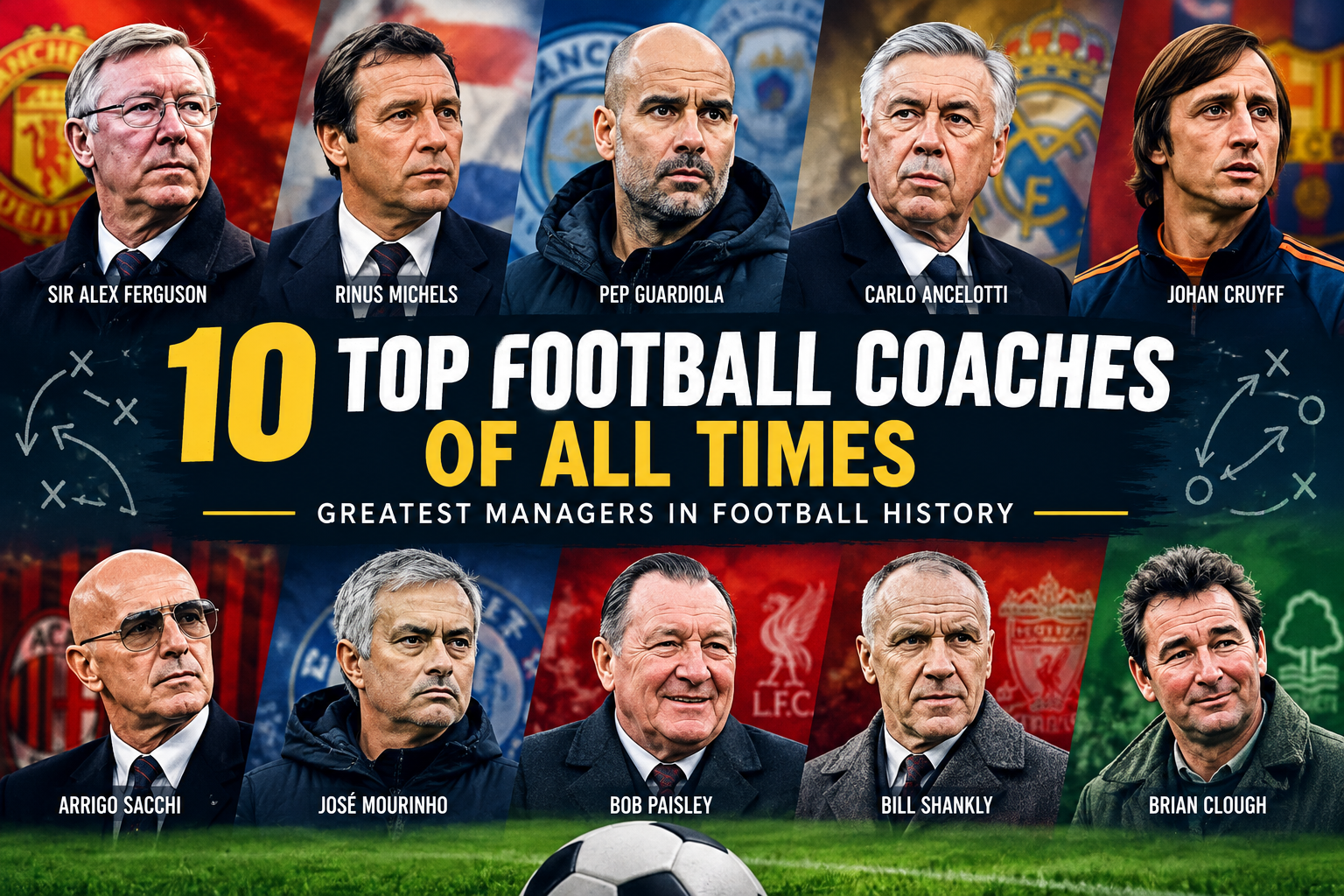
Top10 Football Coaches of All Time: Greatest Managers in Football History
Top10 Football Coaches of All Time: Greatest Managers in Football History
Football has produced thousands of managers, but only a select group have changed the sport through their tactical ideas, leadership, trophies, player development and long-term influence.
From the revolutionary Total Football philosophy of Rinus Michels to the sustained success of Sir Alex Ferguson, the tactical innovations of Arrigo Sacchi and the modern positional football associated with Pep Guardiola, the history of the game is filled with coaches who transformed teams and influenced generations.
Choosing the 10 top football coaches of all time is not an exact science. Different generations value different achievements. Some managers are remembered primarily for trophies, while others are celebrated because their tactical ideas changed how football was played.
This list considers several factors:
- Major trophies won
- Longevity at the highest level
- Tactical innovation
- Success in different competitions
- Ability to rebuild teams
- Player development
- Influence on future coaches
- Impact on football history
With those factors in mind, here are 10 managers whose careers have had an extraordinary impact on world football.
1.Sir Alex Ferguson
Nationality: Scottish
Best known for: Manchester United, Aberdeen
Major achievement: Two European Cups/Champions League titles with Aberdeen and Manchester United combined?
Sir Alex Ferguson stands among the most successful and influential managers in football history.
His career is particularly remarkable because of its longevity and his ability to rebuild successful teams repeatedly. Ferguson first established himself at Aberdeen, where he broke the traditional dominance of Scotland’s major clubs and achieved historic European success.
His move to Manchester United in 1986 eventually transformed the club into one of the most dominant forces in English football.
During his Manchester United career, Ferguson won 13 Premier League titles, five FA Cups and two UEFA Champions League titles, among numerous other honours. The Premier League records list 528 wins from 810 matches for Ferguson, alongside his 13 league titles.
Ferguson’s greatest achievement
Perhaps his greatest strength was his ability to adapt.
Manchester United went through several different generations under Ferguson. The club successfully transitioned from the era of players such as Eric Cantona and Mark Hughes to the generation of David Beckham, Ryan Giggs and Paul Scholes, and later to Cristiano Ronaldo, Wayne Rooney and other stars.
He also developed a reputation for making important tactical and personnel changes during matches.
Why Ferguson changed football
Ferguson demonstrated that elite management is about much more than tactics.
His leadership involved:
- Squad rebuilding
- Youth development
- Recruitment
- Psychological management
- Tactical adaptation
- Maintaining standards over decades
- Managing different generations of players
His achievements have made him one of the central figures in discussions about the greatest football managers ever.
2. Rinus Michels
Nationality: Dutch
Best known for: Ajax, Barcelona, Netherlands
Famous philosophy: Total Football
Rinus Michels was one of the most influential tactical thinkers in football history.
FIFA has described Michels as the architect behind the Netherlands’ revolutionary football of the 1970s and notes that he was named FIFA Coach of the Century.
Michels became closely associated with Total Football, a system built around positional interchange, movement, technical ability and collective understanding.
Instead of treating positions as rigid areas of the pitch, Total Football encouraged players to understand multiple roles.
Ajax and Total Football
At Ajax, Michels developed a team that became one of the defining sides of European football.
His philosophy helped create the environment in which Johan Cruyff developed into one of the greatest players in football history.
Michels later took his ideas to the Netherlands national team.
The Dutch team reached the 1974 World Cup final, producing football that attracted worldwide attention despite ultimately losing to West Germany.
European Championship success
Michels eventually achieved international glory when the Netherlands won the 1988 European Championship.
His career demonstrated that a manager’s legacy does not depend only on the number of trophies won. Tactical ideas can survive for generations.
His influence
The coaching philosophy associated with Michels influenced Johan Cruyff, and through Cruyff it became deeply connected with Barcelona’s football identity.
That coaching tree continues to influence modern football.
3. Pep Guardiola
Nationality: Spanish
Best known for: Barcelona, Bayern Munich, Manchester City
Pep Guardiola represents one of the defining managerial figures of modern football.
His coaching career became globally recognized at Barcelona, where he led a team built around possession, positional structure, technical excellence and coordinated pressing.
The Barcelona side of the late 2000s and early 2010s became one of the most influential club teams of the modern era.
Barcelona revolution
Guardiola inherited and developed a squad containing players such as Lionel Messi, Xavi Hernández, Andrés Iniesta, Sergio Busquets and others.
His Barcelona team combined:
- Short passing
- Positional play
- High pressing
- Ball possession
- Intelligent movement
- Technical excellence
- Tactical flexibility
The result was extraordinary domestic and European success.
Success beyond Barcelona
Guardiola later managed Bayern Munich before moving to Manchester City.
His Manchester City career further demonstrated his ability to adapt his football.
At City, he developed a team capable of dominating possession while also becoming increasingly flexible in its defensive and attacking structures.
Guardiola’s influence is particularly important because his ideas have spread throughout football coaching.
Young coaches and academies around the world study concepts associated with positional play, pressing and structured possession.
UEFA’s records of Champions League managerial appearances place Guardiola among the competition’s most experienced coaches.
Why Guardiola belongs on an all-time list
Guardiola’s case rests on three major factors:
- His trophy record
- His tactical innovation
- His influence on modern football
His career is still part of football’s ongoing history, meaning his ultimate legacy will continue to develop.
4. Carlo Ancelotti
Nationality: Italian
Best known for: AC Milan, Chelsea, Paris Saint-Germain, Real Madrid, Bayern Munich
Carlo Ancelotti is renowned for his adaptability, calm leadership and success across different football cultures.
Unlike managers who became strongly associated with one tactical system, Ancelotti has repeatedly demonstrated the ability to work with different squads and adapt to the strengths of his players.
He has managed major clubs including AC Milan, Chelsea, Paris Saint-Germain, Real Madrid and Bayern Munich.
Champions League success
Ancelotti’s record in European competition is particularly impressive.
He has won the UEFA Champions League multiple times as a manager and has achieved success with more than one club.
UEFA’s historical records place Ancelotti at the top of the Champions League’s all-time managerial appearance list in the data published by the organization.
Tactical flexibility
One of Ancelotti’s defining characteristics is flexibility.
He has used different formations and approaches depending on the players available.
Rather than forcing every team into one rigid tactical model, he has often built systems around the qualities of his squad.
That adaptability has helped him succeed in several of Europe’s biggest leagues.
Leadership style
Ancelotti is also known for his man-management.
Managing a dressing room filled with international stars requires communication, authority and trust.
His career provides a strong example of how successful football management involves more than tactical diagrams.
5. Johan Cruyff
Nationality: Dutch
Best known for: Ajax, Barcelona
Famous philosophy: Possession-based attacking football
Johan Cruyff was already a football legend as a player, but his influence as a coach became equally important.
Cruyff took ideas associated with Rinus Michels and Total Football and helped develop them into a football philosophy that would profoundly influence Barcelona.
UEFA has described Cruyff as the man who reinvented Barcelona, highlighting his importance to the club’s football identity.
The Barcelona Dream Team
As Barcelona manager, Cruyff created the famous Dream Team.
His side won multiple domestic trophies and the European Cup in 1992.
More importantly, Cruyff established principles that influenced the club’s sporting philosophy for decades.
The importance of positional football
Cruyff emphasized:
- Technical ability
- Ball possession
- Passing
- Intelligent movement
- Creating numerical advantages
- Attacking football
- Youth development
These principles became important to Barcelona’s academy system.
The influence later became visible in the football of coaches such as Pep Guardiola.
Why Cruyff’s legacy matters
Cruyff demonstrated that a manager can influence a club far beyond individual trophies.
His ideas became part of Barcelona’s football culture and influenced a generation of players and coaches.
6. Arrigo Sacchi
Nationality: Italian
Best known for: AC Milan, Italy
Arrigo Sacchi changed perceptions of how defensive and attacking football could be combined.
His AC Milan team of the late 1980s and early 1990s became famous for collective pressing, compactness, coordinated movement and an aggressive defensive line.
Sacchi’s Milan won consecutive European Cups in 1989 and 1990, a remarkable achievement that established the team as one of the defining sides of its era.
Sacchi’s tactical revolution
Traditional stereotypes often associated Italian football with deep defending.
Sacchi’s approach challenged that idea.
His teams defended collectively rather than simply relying on individual defenders.
Important principles included:
- Pressing
- Zonal defending
- Compact team shape
- High defensive line
- Coordinated movement
- Quick transitions
Instead of thinking about individual battles, Sacchi emphasized the movement of the entire team.
Influence on modern coaching
His ideas influenced coaches across Europe.
Sacchi’s tactical legacy can still be seen in modern pressing systems.
His Milan team demonstrated how disciplined collective movement could neutralize opponents while creating attacking opportunities.
For that reason, Sacchi is frequently included in discussions about football’s most influential tactical innovators.
7. José Mourinho
Nationality: Portuguese
Best known for: Porto, Chelsea, Inter Milan, Real Madrid
José Mourinho became one of the most recognizable football managers of the 21st century.
His career includes major achievements in Portugal, England, Italy and Spain.
He first attracted worldwide attention by leading Porto to the UEFA Champions League title in 2004.
Porto’s European triumph
Mourinho’s Porto victory was significant because the club defeated some of Europe’s strongest teams on its way to the Champions League trophy.
His tactical preparation, organization and ability to exploit opponents’ weaknesses became central characteristics of his coaching.
Chelsea success
Mourinho then moved to Chelsea, where he helped establish the club as a dominant force in English football.
His first Chelsea spell produced consecutive Premier League titles in 2004/05 and 2005/06.
Inter Milan
His work at Inter produced another extraordinary achievement.
In 2010, Mourinho guided Inter to the Champions League, Serie A and Coppa Italia, completing a historic treble.
Mourinho’s tactical identity
Mourinho has been associated with:
- Defensive organization
- Counter-attacking football
- Tactical preparation
- Opposition analysis
- Set-piece organization
- Squad management
- Mental resilience
His career has also demonstrated an ability to adapt his tactical approach to different competitions and opponents.
UEFA includes Mourinho among the major coaching figures who have shaped Champions League history.
8. Bob Paisley
Nationality: English
Best known for: Liverpool
Bob Paisley is one of the most successful managers in Liverpool’s history and an important figure in English football.
He succeeded Bill Shankly at Liverpool and continued the club’s development into a dominant force in England and Europe.
European dominance
Paisley’s Liverpool won three European Cups during his managerial career.
That achievement alone places him among the most successful managers in European club football history.
He also won multiple English league titles and domestic trophies.
His management approach
Paisley’s strength was not simply winning trophies.
He understood how to maintain a successful team while developing and integrating players.
Liverpool under Paisley became known for:
- Intelligent recruitment
- Technical football
- Tactical discipline
- Squad development
- European experience
- Consistency
His success demonstrated the importance of continuity within a football club.
Liverpool’s coaching dynasty
Paisley was part of the remarkable Liverpool managerial structure that began with Shankly and continued through several successful managers.
His achievements remain an important part of Liverpool’s European history.
9. Bill Shankly
Nationality: Scottish
Best known for: Liverpool
Bill Shankly was one of the most important figures in Liverpool Football Club’s history.
When he arrived at Liverpool, the club was not the European powerhouse it would eventually become.
Shankly helped transform the club’s culture, playing style and infrastructure.
Building Liverpool
Shankly guided Liverpool back to the top level of English football and established the foundations for the club’s future dominance.
He won:
- Three English league titles
- One FA Cup
- Three Second Division titles
- UEFA Cup
His influence went beyond trophies.
Building a football culture
Shankly understood that a football club needed a strong identity.
He helped create the environment that later allowed managers such as Bob Paisley, Joe Fagan and others to continue winning.
Goal’s historical overview of great managers highlights Shankly’s role in Liverpool’s transformation and his three league championships and UEFA Cup.
Why Shankly remains important
Shankly’s greatest contribution may have been building the foundations.
He created systems and standards that allowed Liverpool to become one of Europe’s leading clubs.
That makes his legacy much larger than his personal trophy collection.
10. Brian Clough
Nationality: English
Best known for: Derby County, Nottingham Forest
Brian Clough remains one of English football’s most fascinating managerial figures.
His greatest achievements came with Derby County and Nottingham Forest.
Derby County
Clough transformed Derby County into English champions.
The achievement was particularly significant because Derby had not previously been regarded as one of England’s traditional dominant clubs.
Nottingham Forest
His greatest European success came with Nottingham Forest.
Clough guided Forest to two consecutive European Cups in 1979 and 1980.
Winning the European Cup once is an extraordinary achievement.
Winning it twice in succession with Nottingham Forest made Clough’s record even more remarkable.
His management philosophy
Clough had a distinctive approach to management.
He placed great emphasis on:
- Confidence
- Team spirit
- Direct communication
- Player development
- Tactical organization
- Leadership
He also possessed a strong personality that became part of his managerial identity.
Lasting legacy
Clough’s career demonstrates that great managers do not necessarily need to manage the biggest clubs.
He showed that the right manager, structure and group of players can transform a club’s fortunes.
Honorable Mentions
Any list of the 10 top football coaches of all time will leave out several extraordinary managers.
Some of the most notable include:
Vicente del Bosque
Del Bosque achieved extraordinary success with Real Madrid and Spain.
He won major European club honours with Real Madrid and later guided Spain to the 2010 FIFA World Cup and UEFA Euro 2012.
Marcello Lippi
Lippi achieved major success with Juventus and later guided Italy to the 2006 FIFA World Cup.
Ottmar Hitzfeld
Hitzfeld won the Champions League with both Borussia Dortmund and Bayern Munich, placing him among Europe’s elite club managers.
Helenio Herrera
Herrera was a major figure in the development of highly organized defensive football and achieved enormous success with Inter Milan.
Valeriy Lobanovskyi
Lobanovskyi was one of football’s most innovative coaching thinkers.
He became known for combining tactical organization, physical preparation and analytical approaches to football.
Arsène Wenger
Wenger transformed Arsenal’s football culture and became one of the most influential managers in Premier League history.
He also holds a remarkable longevity record in the competition. BBC Sport’s 2026 historical overview lists Wenger with 828 Premier League games, second only to Ferguson’s 810? [Note: BBC’s article states Wenger 828 and Ferguson 810, while Ferguson’s Premier League Hall of Fame page lists 810; these figures refer to the number of league matches managed and the BBC ranking uses its own historical dataset.]
Jürgen Klopp
Klopp’s Borussia Dortmund and Liverpool teams became famous for intense pressing, transitions and energetic attacking football.
He also guided Liverpool to major domestic and European trophies.
What Makes a Great Football Coach?
There is no single formula for becoming a legendary manager.
However, the careers of the coaches above reveal several common characteristics.
1. Tactical Intelligence
Football is constantly changing.
The best managers understand how to adapt their tactics to new opponents, players and tactical trends.
Michels, Sacchi, Cruyff and Guardiola are particularly important examples of coaches whose ideas influenced the development of the sport.
2. Player Management
A manager can have excellent tactics but still struggle if the dressing room is not united.
Great coaches understand how to communicate with different personalities.
Ferguson, Mourinho and Ancelotti provide different examples of elite player management.
3. Adaptability
Football changes rapidly.
Successful managers must adapt to:
- New formations
- New rules
- New players
- Different leagues
- Different opponents
- Changing expectations
Ancelotti’s career across several major European leagues is an example of this adaptability.
4. Long-Term Vision
Some managers create successful teams immediately.
Others build organizations that remain successful after they leave.
Shankly’s work at Liverpool and Cruyff’s influence on Barcelona demonstrate the importance of long-term thinking.
5. Winning Mentality
Trophies remain one of the most obvious ways to measure managerial success.
However, trophies alone cannot fully explain managerial greatness.
A coach may win fewer trophies but introduce a tactical idea that influences football for decades.
That is why tactical influence and historical impact are important when discussing the greatest coaches.
The Evolution of Football Coaching
The history of football management is also the history of tactical evolution.
The early era
Early managers often focused heavily on basic organization, fitness and player discipline.
The Total Football era
Rinus Michels and his players helped introduce a more fluid approach to positioning and movement.
The pressing revolution
Arrigo Sacchi helped popularize highly coordinated pressing and compact team structures at elite level.
The possession era
Cruyff and later Guardiola developed increasingly sophisticated forms of possession and positional play.
The modern tactical era
Today’s managers combine:
- Data analysis
- Video analysis
- Sports science
- Tactical models
- Recruitment analytics
- Player psychology
- Set-piece coaching
Modern football management has become a multidisciplinary profession.
Top Football Coaches of All Time: Summary
| Coach | Best Known For | Major Legacy |
|---|---|---|
| Sir Alex Ferguson | Manchester United | Longevity, trophies and rebuilding teams |
| Rinus Michels | Ajax & Netherlands | Total Football |
| Pep Guardiola | Barcelona, Bayern & Man City | Positional play and modern possession football |
| Carlo Ancelotti | AC Milan & Real Madrid | European success and tactical adaptability |
| Johan Cruyff | Barcelona | Football philosophy and positional play |
| Arrigo Sacchi | AC Milan | Pressing, compactness and zonal organization |
| José Mourinho | Porto, Chelsea & Inter | Tactical preparation and counter-attacking football |
| Bob Paisley | Liverpool | European dominance |
| Bill Shankly | Liverpool | Club transformation and foundations |
| Brian Clough | Nottingham Forest | European success with an unfancied club |
Frequently Asked Questions About the Greatest Football Coaches
Who is the greatest football coach of all time?
There is no universally accepted answer.
Different assessments emphasize different criteria, including trophies, longevity, tactical innovation and influence.
Sir Alex Ferguson, Rinus Michels, Pep Guardiola, Carlo Ancelotti, Johan Cruyff and Arrigo Sacchi are among the names frequently discussed in all-time debates. Different historical lists place them in different positions.
Who is the most influential football coach?
Rinus Michels is one of the strongest candidates when influence is measured by tactical philosophy.
His Total Football ideas influenced Johan Cruyff and later generations of coaches.
FIFA describes Michels as the architect of Total Football and notes that he was crowned FIFA Coach of the Century.
Who has won the most Premier League titles as a manager?
Sir Alex Ferguson won 13 Premier League titles with Manchester United. The Premier League officially lists him as the competition’s record holder for managerial titles.
Which coach changed modern football the most?
Several managers can be considered influential depending on the aspect being studied.
Michels influenced Total Football, Cruyff influenced positional football and Barcelona’s football philosophy, Sacchi influenced pressing and collective defensive organization, while Guardiola has further developed positional play in the modern era.
Why isn’t every successful manager included?
There are simply too many great managers to include in a list of 10.
Managers such as Vicente del Bosque, Marcello Lippi, Arsène Wenger, Jürgen Klopp, Ottmar Hitzfeld, Helenio Herrera, Valeriy Lobanovskyi and others have outstanding cases.
The purpose of this list is to highlight a mixture of trophy success, longevity, tactical innovation and lasting influence, rather than provide an indisputable ranking.
Final Thoughts
The history of football is not only written by the players who score goals.
It is also shaped by the managers who develop systems, establish cultures, improve players and introduce new ways of understanding the game.
Sir Alex Ferguson demonstrated extraordinary longevity and sustained success. Rinus Michels helped revolutionize tactical thinking. Pep Guardiola has become one of the defining coaches of the modern era. Carlo Ancelotti has shown remarkable adaptability across elite clubs. Johan Cruyff changed the football philosophy of Barcelona, while Arrigo Sacchi transformed ideas about pressing and defensive organization.
Meanwhile, José Mourinho, Bob Paisley, Bill Shankly and Brian Clough created extraordinary teams and left lasting marks on football history.
Ultimately, debates about the greatest football coaches will always continue because football itself keeps changing.
That is part of what makes the sport fascinating.
The next generation of managers may introduce tactical ideas that completely change how we understand the game — just as Michels, Cruyff, Sacchi, Ferguson and others did before them.