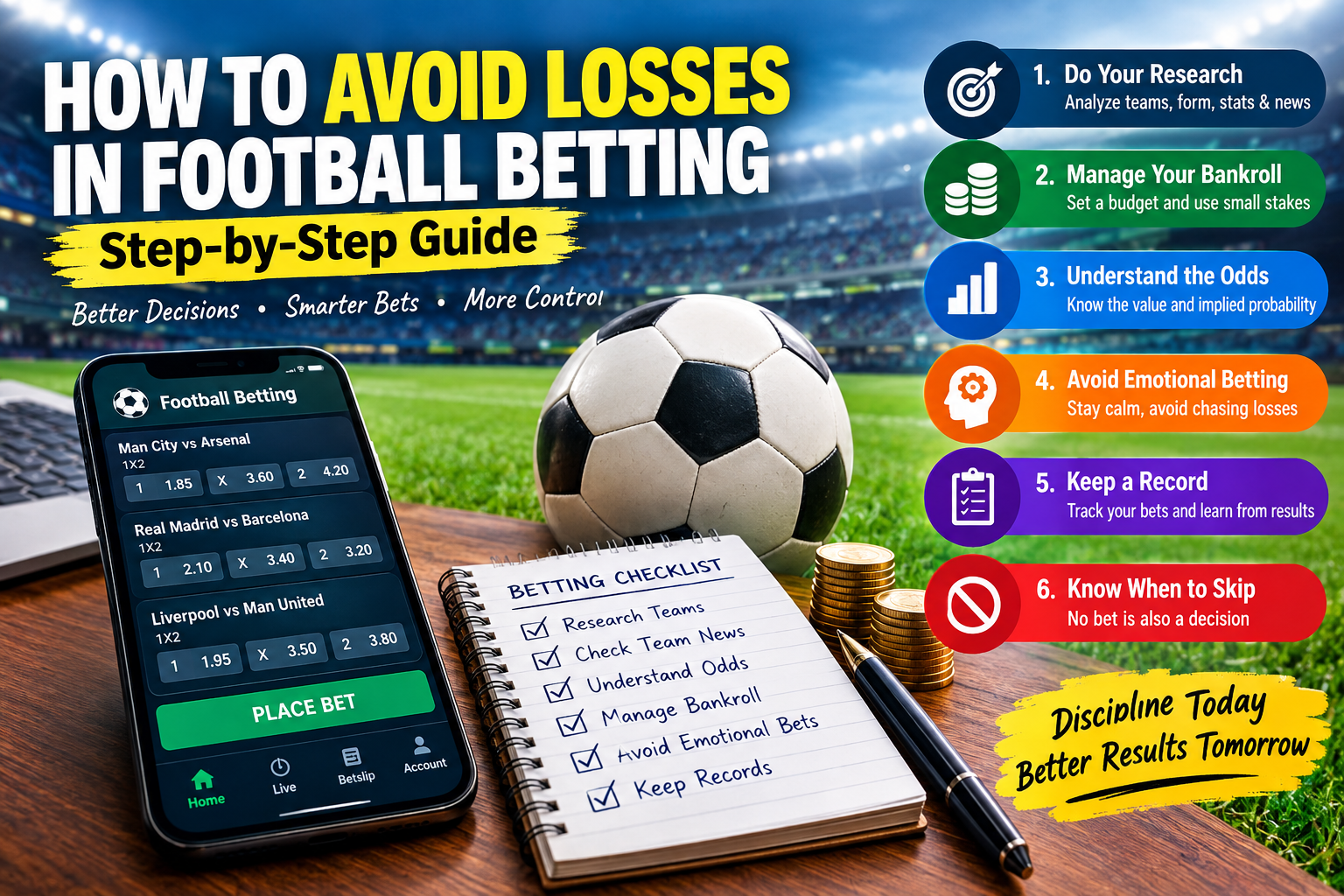
How to Avoid Losses in Football Betting: Step-by-Step Guide for Beginners
How to Avoid Losses in Football Betting: Step-by-Step Guide for Beginners
Football betting can be exciting, but it is important to understand one fundamental reality: there is no strategy that can guarantee profits or completely eliminate losses.
Every football match contains uncertainty. Injuries, red cards, tactical changes, poor finishing, referee decisions, unexpected performances and simple randomness can all affect the final result. Even a carefully researched prediction can lose.
However, bettors can take practical steps to reduce unnecessary losses, manage their bankroll and make more disciplined betting decisions.
This complete guide explains how to avoid unnecessary losses in football betting, how to analyze matches, how to manage your stake, which common mistakes to avoid and how to develop a responsible betting routine.
Responsible betting reminder: Football betting should be treated as entertainment, not as a guaranteed source of income. Never bet money you cannot afford to lose.
What Does “Avoiding Losses” in Football Betting Really Mean?
Avoiding losses does not mean finding a secret formula that wins every football bet.
Instead, it means reducing avoidable mistakes and controlling the amount of money exposed to risk.
A disciplined bettor focuses on:
- Researching matches before betting
- Understanding football odds
- Comparing available markets
- Managing a betting bankroll
- Avoiding emotional decisions
- Keeping accurate betting records
- Avoiding unnecessary accumulators
- Understanding probability
- Accepting losing bets
- Knowing when not to bet
- Setting personal betting limits
The objective is to make each betting decision based on information and a predefined strategy rather than excitement, pressure or desperation.
Step 1: Accept That No Football Bet Is Guaranteed
The first step toward reducing losses is accepting that football is unpredictable.
A team may have won five consecutive matches and still lose its next game. A strong home side can struggle against a defensive opponent. A heavily favored team can concede an early goal and change the entire match.
This means terms such as:
- “sure win”
- “100% fixed match”
- “guaranteed prediction”
- “banker”
- “no-risk bet”
should be approached with extreme caution.
There is no legitimate football prediction method that can guarantee the outcome of a future match.
Even professional analysts and experienced bettors make incorrect predictions.
Why this matters
If you believe every bet should win, one losing bet can encourage emotional reactions such as increasing your next stake or chasing your losses.
A better mindset is:
Every bet carries risk. Your job is to manage the risk, not pretend it does not exist.
Step 2: Set a Football Betting Budget
Before placing any football bets, decide how much money you are willing to risk.
This money should come from your entertainment budget rather than:
- Rent
- Food
- School fees
- Loan repayments
- Emergency savings
- Medical expenses
- Money needed for household bills
For example, suppose someone decides that they can afford to allocate KSh 5,000 to betting for a particular period.
That amount becomes the betting bankroll.
Once the bankroll is exhausted, the person should not automatically deposit additional money to recover losses.
Why a betting bankroll matters
Without a predetermined budget, betting can easily become reactive.
A bettor loses KSh 500 and thinks:
“I only need one big bet to recover it.”
The next stake becomes KSh 1,000.
After another loss, the stake increases again.
This is commonly known as chasing losses, and it can turn a manageable loss into a much larger one.
Step 3: Use Small and Consistent Stakes
One of the most important principles of bankroll management is avoiding oversized stakes.
Instead of risking a large percentage of your bankroll on one match, use a consistent stake system.
For example, if your betting bankroll is KSh 10,000, you might decide that a normal bet represents only a small percentage of your bankroll.
The exact percentage depends on your personal risk tolerance and betting approach.
The important principle is consistency.
Example
Imagine a KSh 10,000 bankroll.
Instead of placing:
- KSh 5,000 on one match
- KSh 3,000 on another
- KSh 2,000 on a third
a disciplined bettor might use much smaller, predefined stakes.
This means one unexpected result does not destroy the entire bankroll.
Avoid “all-in” betting
Never place your entire bankroll on a single football match simply because you consider the selection highly likely.
A high-probability outcome is still not a guaranteed outcome.
Step 4: Understand Football Odds
You cannot manage football betting effectively without understanding odds.
Decimal odds are widely used by bookmakers in many markets.
For example:
Odds of 2.00
A KSh 100 stake would produce KSh 200 in total returns if the bet wins, including the original stake.
Odds of 1.50
A KSh 100 stake would produce KSh 150 in total returns if the bet wins.
Odds of 3.00
A KSh 100 stake would produce KSh 300 in total returns if the bet wins.
The potential return increases with the odds, but so does the implied probability of the outcome being lower.
Implied probability
For decimal odds, a simplified implied probability calculation is:
Implied Probability = 1 ÷ Decimal Odds × 100
For odds of 2.00:
1 ÷ 2.00 × 100 = 50%
For odds of 1.50:
1 ÷ 1.50 × 100 = approximately 66.67%
For odds of 4.00:
1 ÷ 4.00 × 100 = 25%
This calculation helps bettors understand what probability is being represented by the odds.
Step 5: Do Not Bet Simply Because the Odds Are High
High odds can look attractive because they offer a large potential payout.
However, a large potential payout does not automatically mean a good betting opportunity.
For example, a 10.00 selection may look exciting because KSh 100 could theoretically return KSh 1,000.
But the outcome may have a relatively low probability.
Instead of asking:
“How much money can I make?”
ask:
“What probability does this outcome realistically have, and does the price justify the risk?”
That shift in thinking can help reduce impulsive betting.
Step 6: Research the Match Before Betting
Do not select football bets solely because you recognize the teams.
Research the circumstances surrounding the match.
Important factors include:
Recent form
Look at recent performances, but avoid relying exclusively on the last three or five matches.
Consider:
- Results
- Goals scored
- Goals conceded
- Quality of opponents
- Home and away performance
A team beating several weak opponents is not necessarily comparable to a team performing well against stronger opposition.
Home and away records
Some teams perform significantly differently at home and away.
Check:
- Home wins
- Home draws
- Home defeats
- Away wins
- Away draws
- Away defeats
- Goals scored
- Goals conceded
Head-to-head records
Previous meetings can provide context, but they should not be treated as a prediction by themselves.
Teams change managers, players, formations and tactics.
A match played several seasons ago may have little relevance to the current teams.
Step 7: Check Team News
Team news can significantly influence football matches.
Before betting, check for:
- Injuries
- Suspensions
- Rotation
- International commitments
- Rest periods
- Expected lineups
- Goalkeeper changes
- Key defensive absences
- Important attacking absences
For example, a team that normally relies heavily on a particular striker may play differently when that player is unavailable.
Likewise, missing a starting goalkeeper or central defender can affect defensive stability.
Do not assume that a team’s season-long statistics automatically reflect its current lineup.
Step 8: Consider Motivation and Match Context
The importance of a match can influence how teams approach it.
Consider whether the match involves:
- A title race
- Relegation pressure
- European qualification
- A cup competition
- A second-leg knockout situation
- A local derby
- Fixture congestion
- A match immediately before an important cup game
However, be careful with the word motivation.
It is difficult to measure objectively.
Rather than assuming that one team “wants it more,” look for observable evidence such as squad selection, recent rotation, manager comments and competition circumstances.
Step 9: Analyze Goals Instead of Automatically Betting on Winners
Many beginners focus exclusively on the 1X2 market:
- Home win
- Draw
- Away win
But football offers many other markets.
Depending on the bookmaker, these may include:
- Over/Under goals
- Both Teams to Score
- Double Chance
- Draw No Bet
- Asian Handicap
- Team goals
- Corners
- Cards
- Player-related markets
Each market has its own risks.
For example, if predicting the winner appears particularly uncertain, analyzing the expected goal environment may provide a different perspective.
That does not make another market “safe.” It simply changes the type of uncertainty involved.
Step 10: Avoid Betting on Every Match
You do not need to bet every day.
This is one of the most important lessons for beginners.
There may be hundreds of football matches around the world on a given day.
You do not need an opinion on all of them.
Instead, create a selection process.
For example:
- Review the day’s fixtures.
- Identify competitions you understand.
- Remove matches with insufficient information.
- Check team news.
- Compare recent performance.
- Examine relevant statistics.
- Review the odds.
- Decide whether the available price justifies the risk.
- If the evidence is unclear, skip the match.
No bet is also a decision.
Step 11: Avoid Emotional Betting
Emotions are one of the biggest sources of avoidable betting mistakes.
Common emotional situations include:
Betting on your favorite team
Supporting a club and betting on that club are different activities.
A fan may naturally believe their team will win, but betting requires objective analysis.
Betting after an argument
Do not use betting as an emotional outlet.
Betting because you are excited
Excitement can encourage unnecessary bets.
Betting because you are bored
Boredom is not a betting strategy.
Betting because everyone else is doing it
Social media can create the impression that everyone is winning.
You usually do not see the complete record of the people posting winning tickets.
Step 12: Never Chase Losses
This deserves its own section because it is one of the most dangerous betting habits.
Suppose you lose KSh 1,000.
You decide to place KSh 2,000 on the next match because you want to recover the loss.
If that bet loses, you might increase the next stake again.
This creates a cycle:
Loss → larger stake → loss → larger stake → greater exposure
The fact that you lost the previous bet does not make the next match more likely to win.
The next football match is a new event.
A better approach
If you lose a bet:
- Record it.
- Accept the result.
- Do not immediately increase your stake.
- Review your original reasoning later.
- Continue only according to your predetermined bankroll rules.
Step 13: Be Careful With Accumulator Bets
Accumulators, also known as parlays or multiple bets, combine several selections into one ticket.
The potential payout can be attractive.
However, every selection introduces another way for the entire ticket to lose.
For example, suppose you combine five selections.
Even if each individual selection appears reasonable, one incorrect prediction can cause the entire accumulator to fail.
This creates an important distinction:
More selections can increase potential returns, but they also increase the number of outcomes that must go your way.
Do not assume that adding more “safe” selections makes a bet safer.
Step 14: Avoid “Banker” Mentality
Football betting communities frequently use terms such as:
- Banker
- Sure win
- Guaranteed
- Fixed
- Lock
- Certain
These terms can create false confidence.
A team being heavily favored by bookmakers does not mean it cannot lose.
Instead of calling a match a “banker,” describe it in terms of probability and uncertainty.
For example:
“The home team is favored by the market, but the match still contains significant uncertainty.”
That is a more realistic way to approach football betting.
Step 15: Compare Odds When Possible
Different bookmakers may offer different prices for the same market.
Suppose one bookmaker offers:
1.80
while another offers:
2.00
for the same outcome.
The difference matters because the potential return changes.
Over a large number of bets, obtaining better prices can have a meaningful effect on results.
This is sometimes called price shopping.
However, always consider the bookmaker’s terms, market rules, fees where applicable, and whether the markets are genuinely identical.
Step 16: Keep a Betting Record
One of the simplest ways to improve your discipline is to record every bet.
A spreadsheet can include:
| Date | Match | Market | Odds | Stake | Result | Profit/Loss |
|---|---|---|---|---|---|---|
| 17 Sept | Team A vs Team B | Over 2.5 | 1.90 | KSh 100 | Lost | -100 |
| 18 Sept | Team C vs Team D | BTTS | 1.75 | KSh 100 | Won | +75 |
| 19 Sept | Team E vs Team F | Home Win | 2.10 | KSh 100 | Won | +110 |
Over time, your record can reveal patterns.
You may discover that:
- You perform differently across leagues.
- Certain markets produce more losses.
- Accumulators account for many losses.
- You bet too frequently.
- Your average stake increases after losses.
- Your predictions perform differently at different odds ranges.
Without records, it is easy to remember wins and forget losses.
Step 17: Calculate Your Actual Performance
Do not judge your strategy based on a few successful tickets.
A proper record should be evaluated over a meaningful sample.
Important measurements include:
Total bets
How many bets have you placed?
Winning bets
How many were successful?
Losing bets
How many lost?
Total stake
How much money did you risk?
Total returns
How much was returned?
Net profit or loss
Calculate:
Net Result = Total Returns − Total Stakes
Return on Investment
A simplified ROI calculation is:
ROI = Net Profit ÷ Total Stakes × 100
For example, if you staked KSh 10,000 and finished with a net profit of KSh 500:
ROI = 500 ÷ 10,000 × 100
= 5%
The purpose of tracking these figures is not to guarantee future performance. It is to understand what has actually happened in your betting history.
Step 18: Understand Variance
Even a well-researched betting approach can experience losing streaks.
This is known as variance.
For example, a bettor may have several successful bets followed by a series of losses.
A short losing streak does not automatically prove that a strategy has failed.
Likewise, a short winning streak does not prove that a strategy is profitable.
This is why evaluating results over a larger sample is more useful than reacting to individual bets.
Step 19: Do Not Change Your Strategy After One Loss
Imagine you normally stake KSh 100 per bet.
You lose one bet.
Then you decide:
“This strategy doesn’t work.”
You switch to another strategy.
After another loss, you switch again.
Eventually, you are not testing any strategy consistently.
A more disciplined approach is to define your rules before betting and evaluate them over a sufficiently large sample.
Step 20: Learn Basic Football Statistics
Statistics can improve the quality of your research.
Useful metrics include:
- Goals scored per match
- Goals conceded per match
- Expected goals (xG)
- Expected goals against (xGA)
- Shots
- Shots on target
- Possession
- Big chances
- Home performance
- Away performance
- Clean sheets
- Both Teams to Score frequency
- Over/Under goal frequency
Statistics should provide context rather than become a substitute for judgment.
For example, a team’s high average goal tally may partly come from matches against weaker opponents.
Always consider the quality of opposition.
Step 21: Avoid Small-Sample Statistics
One of the most common analytical mistakes is putting too much weight on a small sample.
A team scoring six goals in one match does not necessarily mean it will score three goals in its next match.
Likewise, a team failing to score in two matches does not automatically mean it has a permanent attacking problem.
Ask:
- How many matches are included?
- Who were the opponents?
- Were important players available?
- Were there red cards?
- Was the team rotating its squad?
Statistics become more useful when placed into context.
Step 22: Understand the Difference Between Probability and Certainty
This is at the heart of football betting.
Suppose your analysis suggests that an outcome has a 60% probability.
That does not mean it must happen.
It means that, according to your assumptions, the outcome is expected to occur more often than not over a sufficiently large number of comparable situations.
A 60% probability still means there is a substantial chance that the outcome does not occur.
This is why one losing bet does not necessarily mean the analysis was irrational.
Step 23: Learn When Not to Bet
Sometimes the best way to avoid a loss is not to place the bet.
Consider skipping a match when:
- Team news is unclear.
- Important lineups have not been confirmed.
- The odds have changed dramatically without a clear explanation.
- You lack enough information.
- You are betting purely because there are no other activities.
- You are trying to recover a previous loss.
- You feel pressured to place a bet.
- You cannot explain why your selection has value.
- The stake would put your budget under pressure.
Remember:
You are not required to bet simply because a match is being played.
Step 24: Set Daily and Weekly Limits
A betting plan can include both financial and time limits.
For example, you can establish:
- A maximum daily betting budget
- A maximum weekly budget
- A maximum number of bets
- A maximum stake per bet
- A maximum number of accumulator selections
- A maximum amount deposited
These rules help prevent betting from becoming uncontrolled.
If you reach your predetermined limit, stop.
Step 25: Do Not Borrow Money to Bet
Borrowing money to gamble introduces additional financial pressure.
Avoid using:
- Loans
- Credit intended for essential expenses
- Borrowed money from friends
- Rent money
- School fees
- Emergency funds
If you cannot afford to lose the money, it should not be used for football betting.
Step 26: Be Careful With Betting Tipsters and Social Media
Football prediction pages can provide ideas for analysis, but do not assume that every published ticket represents a complete record.
When evaluating a prediction source, ask:
- Does it publish losing predictions?
- Is there a transparent historical record?
- Are odds and timestamps recorded?
- Does it explain its methodology?
- Does it make guaranteed-profit claims?
- Does it frequently advertise “fixed matches”?
- Does it show only winning tickets?
A screenshot of a winning ticket is not proof of long-term profitability.
Step 27: Do Not Pay for “Fixed Matches”
Claims about guaranteed or fixed football matches deserve particular caution.
If someone claims to possess secret information that guarantees a football result, consider the possibility that the claim is designed to sell a service rather than provide reliable information.
Never risk money simply because someone promises certainty.
Step 28: Create a Pre-Bet Checklist
Before placing any football bet, run through a checklist.
Football Betting Checklist
Match:
- Have I researched both teams?
- Do I understand the competition?
- Have I checked recent performances?
- Have I considered home and away records?
- Have I checked team news?
- Have I considered injuries and suspensions?
- Have I considered fixture congestion?
- Have I checked relevant statistics?
Bet:
- What exactly am I predicting?
- What are the odds?
- What probability do the odds imply?
- Why do I believe the outcome is plausible?
- Is the stake within my predetermined limit?
Mindset:
- Am I calm?
- Am I trying to recover a previous loss?
- Am I betting because I am bored?
- Am I betting because friends recommended it?
- Would I still place this bet if I had not seen someone else’s prediction?
If you cannot answer these questions, consider skipping the bet.
Step 29: Separate Analysis From Betting
A useful habit is to analyze matches without automatically placing bets.
For example:
- Analyze five matches.
- Identify possible outcomes.
- Compare your estimated probabilities with the available odds.
- Select only situations where your reasoning is sufficiently strong.
- Skip the rest.
This prevents the psychological pressure of feeling that every analysis must result in a bet.
Step 30: Review Your Results Regularly
At the end of each week or month, review your betting activity.
Ask:
Financial questions
- How much did I stake?
- How much did I return?
- What was my net result?
- Did I stay within my budget?
Behavioral questions
- Did I chase losses?
- Did I increase stakes emotionally?
- Did I bet more frequently than planned?
- Did I place unnecessary accumulators?
- Did I follow my checklist?
Analytical questions
- Which markets did I use?
- Which leagues did I analyze?
- What odds ranges did I select?
- How many bets were based on proper research?
- Which assumptions were repeatedly wrong?
This review can help identify habits that contribute to unnecessary losses.
Football Betting Mistakes to Avoid
1. Betting more after losing
Increasing your stake simply because you lost the previous bet does not change the probability of the next match.
2. Betting your entire bankroll
One unexpected result can eliminate your betting funds.
3. Following social-media hype
Popular predictions are not necessarily accurate predictions.
4. Betting on every fixture
More bets mean more exposure to risk.
5. Chasing “sure odds”
There are no guaranteed football outcomes.
6. Ignoring team news
A key injury or suspension can change a team’s expected performance.
7. Using too many accumulator selections
Every additional selection creates another condition that must be satisfied.
8. Betting while emotional
Anger, excitement and frustration can lead to poor decisions.
9. Ignoring your records
Without tracking results, you may not know whether your approach is actually working.
10. Treating betting as income
Football betting has financial risk and should not be treated as a guaranteed salary or investment.
A Simple Football Betting Routine
Here is a practical routine beginners can follow.
Step 1: Set your budget
Decide how much you can afford to risk.
Step 2: Select your leagues
Focus on competitions you understand rather than trying to analyze everything.
Step 3: Review fixtures
Identify potentially interesting matches.
Step 4: Research teams
Check form, statistics, home/away performance and relevant context.
Step 5: Check team news
Look for injuries, suspensions and expected lineups.
Step 6: Identify possible markets
Consider whether the match is better analyzed through the result market, goals market or another available market.
Step 7: Check the odds
Understand what probability the odds imply.
Step 8: Decide whether the risk is acceptable
If your analysis is unclear, do not force a bet.
Step 9: Use a predetermined stake
Do not increase your stake because you feel particularly confident.
Step 10: Record the bet
Write down the match, market, odds, stake and reasoning.
Step 11: Accept the result
Whether the bet wins or loses, avoid emotional reactions.
Step 12: Review your records
Use long-term data to understand your betting behavior.
Can You Completely Avoid Losing Money in Football Betting?
No.
There is no reliable football betting strategy that can guarantee zero losses.
The realistic goal is to control exposure to risk and avoid unnecessary financial and behavioral mistakes.
Even sophisticated statistical models cannot remove uncertainty from football.
A prediction can be reasonable and still lose.
Therefore, responsible betting requires accepting losses as a possible outcome of every wager.
How to Become a More Disciplined Football Bettor
Discipline is often more important than finding complicated betting systems.
A disciplined bettor:
- Has a predetermined budget
- Uses controlled stakes
- Researches before betting
- Understands odds
- Keeps records
- Avoids emotional decisions
- Does not chase losses
- Avoids unrealistic guarantees
- Knows when to skip a match
- Reviews results objectively
- Treats betting as entertainment rather than guaranteed income
The most important skill is not predicting every match correctly.
It is managing your decisions when predictions are wrong.
Frequently Asked Questions About Avoiding Football Betting Losses
What is the best way to reduce losses in football betting?
There is no guaranteed method, but disciplined bankroll management, careful research, realistic expectations, record keeping and avoiding emotional betting can help reduce avoidable losses.
Is there a guaranteed football betting strategy?
No. Football matches contain uncertainty, and no legitimate strategy can guarantee a winning outcome.
Should I increase my stake after losing?
Increasing your stake specifically to recover a previous loss is generally known as chasing losses and can increase your financial exposure. A predetermined staking plan avoids this reaction.
Are accumulator bets safer because they contain several strong teams?
No. Every additional selection creates another condition that must be correct for the accumulator to win.
Should I bet on my favorite football team?
Being a supporter can introduce emotional bias. If you choose to bet, separate your personal support from your objective analysis.
How much should I bet on football?
There is no universally appropriate amount. The key principle is to use only money you can afford to lose and establish your stake limits before betting.
Can football statistics guarantee winning bets?
No. Statistics can help structure analysis, but they cannot eliminate uncertainty.
What should I do after a losing bet?
Accept the result, record it and avoid immediately increasing your stake to recover the money.
Is it better to bet every day?
Not necessarily. Betting frequency should not be driven by the number of matches available. Skipping matches is a legitimate part of a disciplined approach.
How can I tell whether my betting strategy works?
Keep a complete record of your bets and evaluate performance over a sufficiently large sample rather than relying on a short winning or losing streak.
Final Thoughts: How to Avoid Unnecessary Losses in Football Betting
Football betting will always involve uncertainty.
The safest approach is not to search for a mythical “100% winning formula,” but to develop a structured process for making decisions and controlling risk.
Start by setting a realistic budget. Use small, predetermined stakes. Research matches carefully. Understand odds and probability. Check team news. Keep detailed records. Avoid emotional betting, excessive accumulators and loss chasing.